
In China’s crop-input trade, one word comes up in almost every granule negotiation: 药肥, or yaofei — literally “medicine fertilizer”. Export catalogs render it as a pesticide–fertilizer mixture, an insecticide fertilizer combination, or mediated fertilizer. Whatever the label, the proposition is the same: crop nutrition and crop protection delivered together, in one granule, in one pass. This guide explains what the products are, why growers buy them, what can go wrong, and what importers and distributors should check before ordering. BNSD Agro’s own granule line serves as a worked example — see the full granule range.
What Is Mediated Fertilizer (药肥)?
A pesticide–fertilizer mixture is a granular product that combines a plant-nutrient base — typically NPK in a crop-specific ratio — with a registered pesticide active, most often an insecticide aimed at soil and early-season pests. Two manufacturing routes exist:
- Co-formulated (in-granule) products, where the active is built into the granule matrix during production, so every granule carries nutrition and active together.
- Pesticide coated fertilizer granules, where a finished NPK granule is film-coated with the active plus a binder or polymer. This is the more common route, and the easier of the two to verify analytically.
Both routes are sold as a single SKU and applied once, usually at sowing. In China the category is regulated as a pesticide — the active ingredient must hold an ICAMA registration — while the nutrient content is declared separately on the label. Regulatory treatment differs by country: some markets classify combination products as plant-protection goods, others as fertilizers with an added active. Buyers should confirm the classification at the destination before contracting.
Why Growers Adopt Insecticide–Fertilizer Combinations
The commercial logic is straightforward. A grower who applies an insecticide fertilizer combination at planting replaces two field operations with one:
- One pass, two jobs. Nutrition and soil-pest control go down together, saving a separate broadcast or spray round at a time when labor and machinery windows are tight.
- Better timing. Soil pests such as wireworms, white grubs and early-season armyworms feed at or below the soil surface before visible damage appears; a granule puts the active where they feed.
- Placement efficiency. The active sits in the root zone rather than on the foliage, which suits products with soil residual and reduces early-season foliar handling.
- Standard equipment. Quality granules flow through conventional fertilizer spreaders and seed drills without modification.
For distributors, the same logic explains the category’s growth: it converts two purchase decisions into one SKU, with consumption tied to the planting calendar rather than to emergency spraying.
Which Actives Are Typically Used
The actives that dominate China 药肥 granules are established molecules with well-documented soil and early-season performance:
- Chlorantraniliprole (IRAC 28, diamide) — long residual activity against Lepidoptera larvae such as armyworms and cutworms.
- Clothianidin (IRAC 4A, neonicotinoid) — soil-dwelling and early-season chewing and sucking pests.
- Thiamethoxam (IRAC 4A) — a similar spectrum, common in maize and sugarcane granules.
- Bifenthrin + clothianidin (IRAC 3A + 4A) — pyrethroid knockdown paired with neonicotinoid residual, a frequent pairing in water-soluble granules.
For buyers, the practical questions are not the actives themselves but their regulatory status in the destination market and the loading rate per granule, which together determine cost per hectare and field performance.
Quality Checkpoints Before You Buy
Granule quality is where mediated fertilizer sourcing succeeds or fails. Four checkpoints matter most.
Uniform active distribution
Sampling variance between granules is the classic failure mode of coated products. If the coating fraction segregates in transit, one pass of the spreader can deliver a heavy dose at the headland and almost nothing mid-field. Ask the supplier how homogeneity is controlled and tested, batch by batch. A manufacturer with in-house HPLC and GC laboratories and batch-level QC can show real data rather than assurances.
Granule strength and dust
Weak granules break into fines; fines cake, segregate and drift. Check particle size distribution, hardness and dust content on arrival samples, and how the packaging survives stacking and humid container transport. Dust control is a core competence of experienced water-dispersible granule (WDG)/wettable powder (WP) producers, but granule lines deserve their own audit.
NPK accuracy
The nutrient guarantee is a legal claim. Verify that the declared N–P–K matches laboratory analysis, and that the nutrient base suits the crop: sulphate-based potassium, for example, is widely preferred for peanut, potato and ginger programs, while high-nitrogen bases suit maize.
Crop-specific formulation
A one-formula-fits-all blend rarely fits any crop. Nutrient ratios, active rate and granule size should be matched to the crop and the planting method — which is why leading suppliers build the line around crop-specific formulas rather than a single universal blend.
Where the Format Fits: Four Crops
The pesticide-fertilizer mixture format has found its strongest fit in crops where sowing coincides with soil-pest pressure:
- Maize — early-season chewing pests and soil insects at planting, supported by high-nitrogen bases.
- Peanut — white grubs are the classic target; a placed granule protects the pod zone.
- Potato, sweet potato and ginger — planted as tubers or rhizomes directly into soils where cutworms and grubs are active.
- Sugarcane — a long season and cane-set planting make granules the standard delivery form in many growing regions.
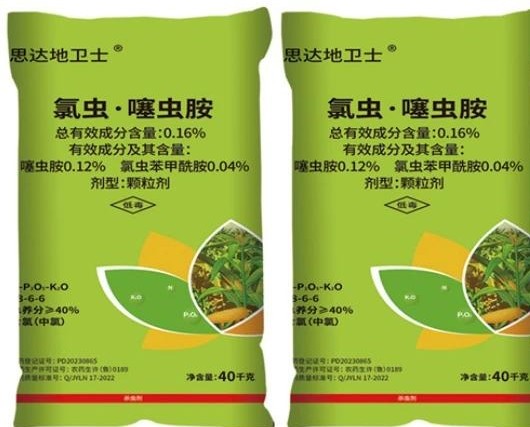
Sida Guard: A Worked Example from BNSD Agro
Shandong Bainong Sida Biotechnology Co., Ltd. (BNSD Agro), a national-designated pesticide manufacturer founded in 2003 and based in the Qingzhou Economic Development Zone, Weifang, Shandong, sells a crop-specific mediated fertilizer line under the Sida Guard name (company product information). The active across the line is 0.16% chlorantraniliprole + clothianidin granule (GR); the NPK base changes with the crop:
| Sida Guard formula | Active (company data) | NPK | Nutrient base | Crop fit | Pack |
|---|---|---|---|---|---|
| Maize | 0.16% chlorantraniliprole + clothianidin GR | 28-8-6 | standard NPK base | maize | 40 kg bag |
| Peanut | 0.16% chlorantraniliprole + clothianidin GR | 12-18-15 | sulphate-based | peanut | 40 kg bag |
| Potato & ginger | 0.16% chlorantraniliprole + clothianidin GR | 15-9-21 | sulphate-based | potato, sweet potato, ginger | 40 kg bag |
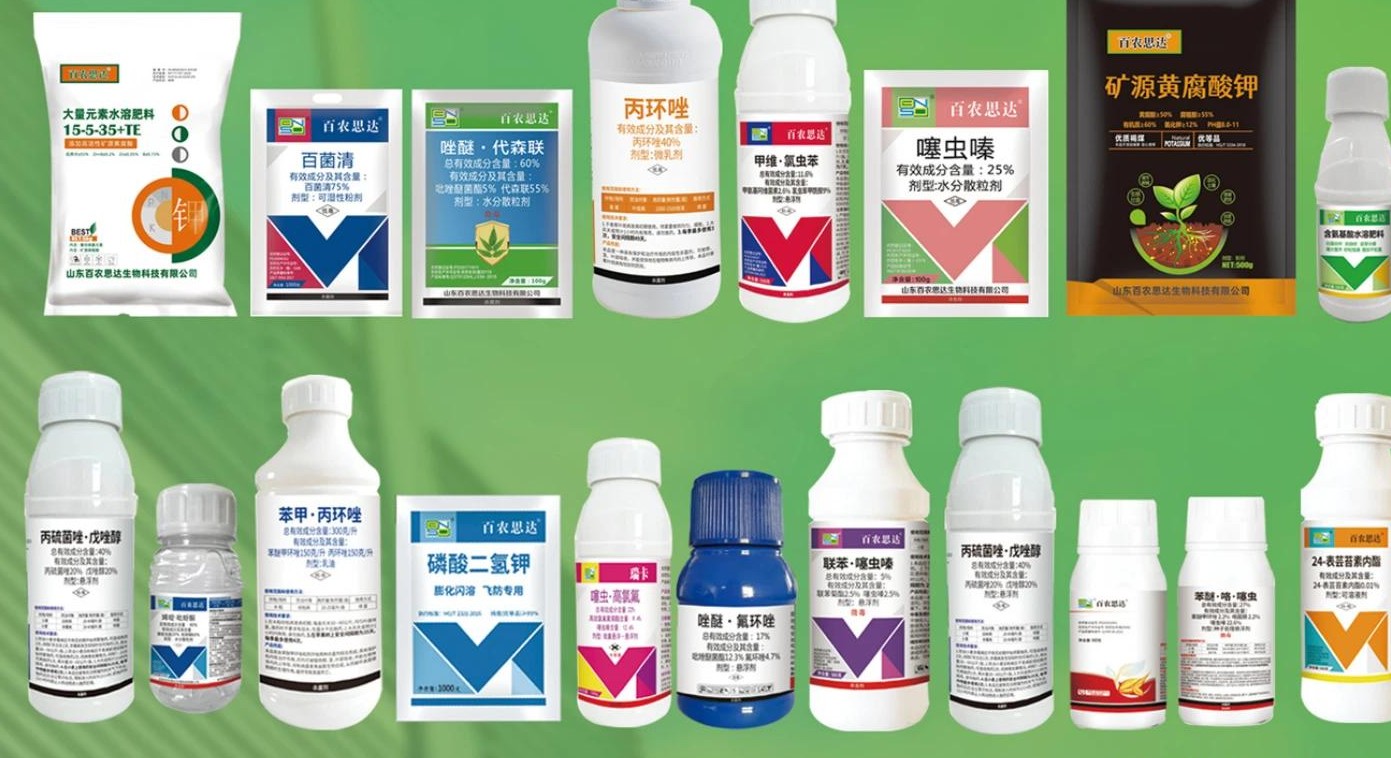
The company also lists a 1% bifenthrin + clothianidin water-soluble granule for situations that call for a pyrethroid–neonicotinoid pairing. Demand for the category is visible in the company’s order book: BNSD reports an RMB 200 million mediated-fertilizer export order for 2026 (company information). The granule line sits alongside 7 insecticide–fertilizer granule SKUs within a 99-product export portfolio, backed by 70 ICAMA registrations and ISO 9001/14001/45001 certification (company information).
Sourcing from China: Practical Notes
- Classification first. Confirm whether the destination market treats the combination as a pesticide, a fertilizer, or both, before signing.
- Fix the specification in writing: active and content, NPK guarantee, nutrient base, granule size, dust limits and pack format.
- Insist on batch COAs, and consider third-party inspection such as SGS or buyer inspection before shipment.
- Discuss OEM early. An experienced toll formulator can adjust the NPK ratio, active and pack. BNSD offers OEM/toll manufacturing across more than eight formulation types, with packs from 10 mL to 40 kg, plus R&D and registration support (company information) — see the full product portfolio.
- Plan logistics. 40 kg bags, palletization and container humidity all affect granule condition on arrival.
FAQ
Is a pesticide–fertilizer mixture registered as a pesticide or a fertilizer?
In China, combination products are registered as pesticides — the active ingredient requires an ICAMA registration — while nutrient content is declared on the label as a guarantee. Other jurisdictions differ: some treat the product as a fertilizer with an added plant-protection agent, others require dual compliance. Verify the classification in your market before shipping.
Can the NPK ratio, active and pack be customized?
Most established Chinese producers offer OEM. BNSD Agro, for example, supports toll formulation across more than eight formulation types, with packs from 10 mL sachets to 40 kg bags, and provides R&D and registration support for destination-market needs (company information).
How do coated granules differ from co-formulated ones?
Coated granules are finished NPK granules carrying an active film on the surface; co-formulated granules carry the active inside the granule matrix. Coated products are easier to analyze and adjust; co-formulated products can offer longer release behavior. Both perform well when homogeneity, granule strength and dust are properly controlled.
What should a first shipment include?
A signed specification sheet, batch COAs, and retained arrival samples for testing. Many buyers also run a buffer sample through an independent laboratory to confirm active content and NPK against the guarantee before distribution.
To discuss granule specifications, request samples or review customization options, message the export team.
WhatsApp / WeChat: +86 199 0636 5856