
Ask a distributor which neonicotinoid to stock and the honest answer is: it depends on the crop list you serve, not on which molecule is “best”. Thiamethoxam, imidacloprid, acetamiprid and clothianidin all belong to IRAC group 4A — the same mode of action — yet they are registered on different targets, sold at very different pack sizes and deployed in different ways: foliar spray, seed treatment or root drench. This guide compares the four actives side by side as they are actually registered and packed at BNSD Agro (Shandong Bainong Sida Biotechnology Co., Ltd.), so buyers can position each one where it earns its shelf space. The full range sits on the insecticides catalogue, and samples are available through the contact page.
One Mode of Action, Four Positionings
Neonicotinoids act as agonists at the insect nicotinic acetylcholine receptor — IRAC group 4A. Three shared properties define the class:
- Systemic, xylem-mobile movement. Applied to foliage, soil or seed, the active is taken up and distributed through the plant’s water stream, reaching sucking pests hidden on undersides and inside leaf whorls.
- Contact plus stomach activity against sucking pests. Aphids, planthoppers, thrips, whitefly and leafhoppers are the class’s core targets; the systemic fraction reaches what a contact spray misses.
- A single target site. All 4A actives share one binding site, which is the class’s commercial strength and its resistance-management weakness at the same time — rotation discipline (below) is not optional.
Because the mode of action is shared, what actually differentiates the four actives in trade is registration fit, rate structure and formulation format. That is what the table below maps.
The Four-Way Comparison at Label Level
| Active | BNSD formulation | Registered targets (Chinese label) | Label rate |
|---|---|---|---|
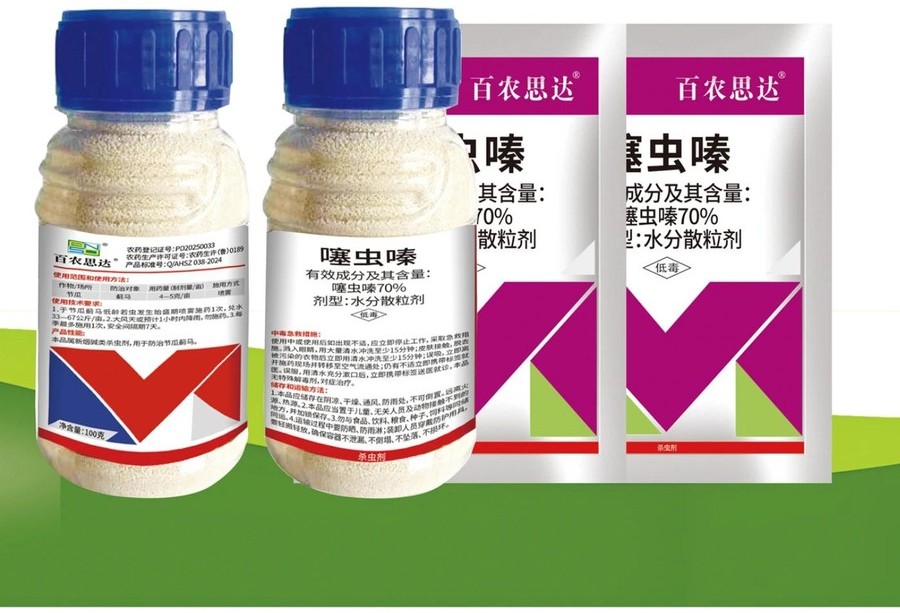
| Thiamethoxam | 70% water-dispersible granule (WDG) | Chieh-qua thrips | 4–5 g/667 m² |
| Thiamethoxam | 25% WDG | Rice planthopper | 3–8 g/667 m² |
| Thiamethoxam | 25% WDG | Welsh onion thrips | 10–20 g/667 m² |
| Thiamethoxam | 25% WDG | Garlic root maggot / chive maggot | 180–360 g / 180–240 g per 667 m², drench |
| Thiamethoxam | 35% suspension concentrate (SC) (seed treatment) | Wheat aphids | 340–450 mL/100 kg seed |
| Imidacloprid | 10% wettable powder (WP) | Rice planthopper | 20–40 g/667 m² |
| Imidacloprid | 10% WP | Fungus gnat on mushroom beds | 1–2 g/m² |
| Imidacloprid | 70% WDG | Cabbage aphids | 1.5–2 g/667 m² |
| Acetamiprid | 70% WDG | Cucumber aphids | 1.5–2.5 g/667 m² |
| Clothianidin | 48% SC | Chive maggot, root drench | 40–50 mL/667 m² |
All rates are Chinese registration label rates; 667 m² equals one mu, roughly 1/15 hectare. In your own market the destination label governs — registration scope and rates differ country by country, and this table is a positioning reference, not a spray recipe for another jurisdiction.
What Each Active Is Actually For
Thiamethoxam — the portfolio breadth play. At BNSD Agro it is the widest-spectrum neonicotinoid line: a 70% WDG for high-concentration foliar use on vegetable thrips, a 25% WDG spanning rice planthopper, onion thrips and Allium root-maggot drenches, a 35% SC built as a seed treatment for wheat aphids, and a 3% granule (GR) for sugarcane stem borer. One active family, four formats — which is why thiamethoxam anchors most program discussions.
Imidacloprid — the established workhorse. The longest-standing molecule of the four, registered here as a 10% WP for rice planthopper and mushroom-bed fungus gnat, and as a 70% WDG for cabbage aphids at grams-per-mu rates. Its familiarity with growers is a real merchandising asset in price-sensitive retail channels.
Acetamiprid — the aphid specialist. Registered as a 70% WDG for cucumber aphids at 1.5–2.5 g/667 m², packed in 4 g sachets for smallholder retail and 100 g jars for farm use. Acetamiprid is widely appreciated in field practice for dependable aphid knockdown under cooler conditions, which suits early-season vegetable programs.
Clothianidin — the soil-use specialist. The 48% SC is registered for chive maggot as a root drench at 40–50 mL/667 m² — a use built on the molecule’s soil persistence and root-system uptake rather than foliar knockdown. A 26% lambda-cyhalothrin + clothianidin SC extends it to garlic root maggot drench at 2000–4000×.
Pack Ladder: Where the Margins Are
The same class is merchandised completely differently by format. The gram-per-mu products (thiamethoxam 70% WDG, imidacloprid 70% WDG, acetamiprid 70% WDG) live in sachets — 2 g, 4 g and 10 g×800 sachet packs — aimed at smallholder retail. The drench and seed-treatment products move in 100 g to 1 kg bottles and, for thiamethoxam 70% WDG, up to 25 kg drums for plantation-scale programs. When comparing “neonicotinoid prices” across suppliers, always compare the pack ladder and content at the same time; a sachet-grade quote and a drum-grade quote are different products commercially.
Stewardship: Keeping 4A Working and Pollinators Safe
Two disciplines apply to every product in this table:
- Rotate modes of action. IRAC guidance for group 4A: avoid repeated applications of group 4A products against successive pest generations on the same crop. Rotate with unrelated groups — pyrethroids (IRAC 3A), flonicamid combinations, or other registered alternatives — and use built-in mixtures such as the 22% thiamethoxam + lambda-cyhalothrin SC (wheat aphids and tea leafhopper, 5–7 mL/667 m²) to carry two groups in one pass.
- Protect pollinators. Neonicotinoids are toxic to bees and other pollinating insects. Do not apply during flowering, respect designated application windows and buffer requirements in your jurisdiction, and follow the increasingly strict country-level restrictions on neonicotinoid uses in destination markets — several markets restrict certain outdoor foliar and seed-treatment uses outright. Verifying your destination’s current approval status before ordering is part of the import job, and the supplier should support with registration documents and technical data.
FAQ
Are thiamethoxam, imidacloprid, acetamiprid and clothianidin the same mode of action?
Yes — all four are IRAC group 4A nicotinic receptor agonists. They differ in registration targets, rate structure and formulation format, which is why crop fit, not chemistry class, decides which one to stock.
Which neonicotinoid should a distributor stock first?
Start from your crop list: broad sucking-pest and Allium drench demand points to thiamethoxam (four formats at BNSD Agro), rice and vegetable planthopper/aphid demand to imidacloprid, cucumber and vegetable aphids to acetamiprid 70% WDG, and chive-maggot drench demand to clothianidin 48% SC.
Can neonicotinoids be tank-mixed?
Built-in two-group mixtures are the cleaner route — for example the 22% thiamethoxam + lambda-cyhalothrin SC, which pairs a group 4A with a pyrethroid (IRAC 3A). For any tank mix, follow the label and jar-test first.
How should group 4A resistance be managed?
Limit consecutive group 4A applications against the same pest generation, rotate with unrelated IRAC groups each pass, and treat built-in mixtures as the rotation delivered within a single spray.
WhatsApp / WeChat: +86 199 0636 5856