
Seedling losses happen fast. Damping-off can take a nursery bed from uniform stand to bare patches within days of emergence, and replanting in the same season costs growers both calendar time and seed money. Because the damping-off complex involves several unrelated organisms at once — oomycetes and true fungi together — a single-mode product rarely covers the whole problem. That is the logic behind the metalaxyl + hymexazol 30% AS registered by BNSD Agro (Shandong Bainong Sida Biotechnology Co., Ltd.): two actives, two modes, aimed at the seedbed itself. This guide explains the pairing, the registered use and the nursery application notes that decide results. The full portfolio sits on the fungicides catalogue, and samples or registration documents are available through the contact page.
Two Modes in One Product
Metalaxyl — systemic oomycete specialist (FRAC 4). Metalaxyl belongs to the phenylamide family: it inhibits RNA polymerase I in oomycetes, blocking the synthesis the pathogen needs to grow. It is genuinely systemic — taken up by roots and seedlings and translocated through the young plant — which is exactly what a seedling treatment needs, since the pathogen attacks below and above the soil line. Metalaxyl is specific to oomycetes: Pythium and Phytophthora species and the downy mildew relatives, which are the single most important damping-off agents worldwide.
Hymexazol — soil-disinfectant partner (isoxazole family). Hymexazol works in the soil phase against the fungal side of the seedling-disease complex, with long-established use in China and Japan against damping-off organisms such as Fusarium and Pythium. It is also widely reported to support seedling vigour and root development after treatment, a secondary effect growers value on seedling beds.
Why the pairing works. Damping-off is not one disease. The name covers seed rot, pre-emergence kill and post-emergence stem collapse caused by a mixed group of soil organisms, and the mix shifts with soil, temperature and water management. Metalaxyl alone covers the oomycete side with a single high-resistance-risk site; hymexazol extends the spectrum to the fungal side and works on the soil itself. Together they cover the complex — and the built-in two-mode structure is also more rotation-friendly than either active deployed alone.
Registered Use and Chinese Label Rate
| Product | Registered target (Chinese label) | Label rate |
|---|---|---|
| Metalaxyl + hymexazol 30% AS | Rice seedling damping-off | 1.2–1.5 g/m² |
All rates are Chinese registration label rates. Note the rate expression: per square metre, not per 667 m². Nursery registrations are written this way because the treatment unit is the seedbed or tray, not the field — the rate is spread across the bed area, uniformly. Converting for planning purposes: 1.2–1.5 g/m² equals roughly 800–1000 g per 667 m² of nursery bed area, and a hectare of beds takes 12–15 kg.
In your own market the destination label governs — registration scope, application method and rates differ country by country, and the figures above are a positioning reference, not a spray recipe for another jurisdiction.
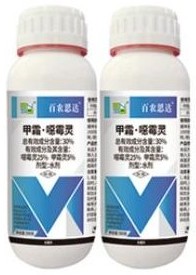
The aqueous solution (AS) formulation dissolves clear in water, which suits the watering-can and drenching work typical of nursery operations. Packaging runs 10 g × 800 sachets for smallholder retail, 100 g × 80, 500 g × 20 and 1 kg × 12 bottles for institutional and farm-scale nursery programs.
Nursery Application Notes
Nursery results depend less on the molecule than on how the treatment fits seedbed management. The standard practices:
- Treat the bed, not just the plant. Per-metre-squared rates are designed for seedbed soil or tray substrate treatment — uniform distribution over the bed area, followed by watering in so the actives move into the root zone where the infection starts.
- Apply evenly. Hot spots burn seedlings and skipped strips leave disease corridors. Split the measured dose into two passes at right angles for even coverage.
- Manage water and ventilation. Damping-off risk rises with standing moisture and crowded, shaded seedlings. Well-drained substrate, thin sowing and air movement do as much for the program as the fungicide itself — the treatment protects, the husbandry prevents.
- Plan rotation for the metalaxyl component. FRAC 4 carries a high resistance risk when used alone and repeatedly. Rotate nursery programs with oomycete actives of other groups and avoid consecutive FRAC 4 cycles season after season; the resistance-management guide sets out the rotation framework.
- Keep to label scope. Seedling-disease registrations differ widely between markets. Confirm the destination label before positioning the product for uses beyond rice seedling damping-off.
Sourcing an Aqueous Solution for Nursery Use
An AS is the simplest formulation to judge, which makes sample checks decisive. The active should dissolve clear in water with no sediment, film or floating matter, and the solution should stay stable through the hot and cold cycles of the shipping route. On samples, confirm that a measured dose disperses evenly into cool nursery water without clouding out, and that content checks out by HPLC against the registration standard — at BNSD Agro every batch is analysed and released on this basis before shipment (company practice). Commercially, the sachet run matters most: nursery programs are bought sachet by sachet, so the 10 g × 800 run is what carries the retail offer, while the 100 g, 500 g and 1 kg bottles serve the institutional buyers who treat beds by the hectare.
FAQ
What is metalaxyl + hymexazol 30% AS registered for?
On the Chinese label: rice seedling damping-off at 1.2–1.5 g/m², applied as a seedbed treatment. Which uses apply in your market is decided by the destination label.
Why combine metalaxyl with hymexazol?
Damping-off is a mixed disease: oomycetes such as Pythium plus true fungi such as Fusarium. Metalaxyl covers the oomycete side systemically (FRAC 4); hymexazol adds the fungal side and works in the soil phase. The two modes together cover the complex that neither active covers alone.
What does the g/m² rate mean in practice?
The treatment unit is the seedbed or tray, so the label expresses the rate per square metre of bed area — 1.2–1.5 g/m², roughly 800–1000 g per 667 m² of bed. Spread uniformly over the bed and water in.
How should buyers position this product?
As a nursery/seedbed solution for the seedling-disease complex, backed by an AS formulation that dissolves clear for drenching work and a sachet-to-bottle pack ladder (10 g × 800 up to 1 kg × 12). Confirm destination-label scope and rotate FRAC 4 programs to protect the metalaxyl component.
WhatsApp / WeChat: +86 199 0636 5856