
Few pyrethroids generate as many “which one do I actually need?” enquiries as lambda-cyhalothrin, because the same active sits at the centre of a four-step concentration ladder. Importers ask why one catalogue lists a 25 g/L EC alongside a 2.5% EW, a 5% EW and a 10% EW, which of those fits a retail channel versus a plantation program, and where the two-way thiamethoxam combination comes in. This guide answers those questions from the standpoint of a Chinese manufacturer, using the registered uses and label rates on file at BNSD Agro (Shandong Bainong Sida Biotechnology Co., Ltd.).
IRAC Group 3A Basics: Contact, Stomach and Fast Knockdown
Lambda-cyhalothrin is a synthetic pyrethroid classified in IRAC group 3A. Group 3A actives modulate voltage-gated sodium channels in the insect nervous system, and three practical properties follow from that chemistry:
- Contact and stomach action. The pest is killed when it touches the treated surface or feeds on it. There is no meaningful systemic movement inside the plant, so coverage matters: the spray deposit has to reach the feeding zone.
- Fast knockdown. Pyrethroids are known for rapid cessation of feeding and movement, which is why they are often positioned against chewing caterpillars and as the “flushing” partner in mixed programs.
- Broad spectrum against chewing pests. Caterpillars, beetles, leafhoppers and sucking pests are all within the general activity range, though the registered target list — not the chemistry — decides what can be claimed on a label.
Because the molecule works on a single, well-characterised target site, resistance management is a genuine commercial issue: overuse of group 3A in any one area shows up quickly in the field. That shapes the rotation advice near the end of this guide.
The Product Ladder: From 25 g/L EC to 10% EW
On the Chinese registrations held by BNSD Agro, lambda-cyhalothrin spans four single-active formulations. Each step up in content halves the label rate per mu:
| Formulation | Registered use (Chinese label) | Label rate | Pack sizes |
|---|---|---|---|
| 25 g/L EC | Cabbage worm on brassicas | 30–40 mL/667 m² | 500 mL × 20; 1 L × 12 |
| 2.5% EW | Cabbage worm | 20–30 mL/667 m² | 75 g × 100 through 1 kg × 12 |
| 5% EW | Cabbage worm | 10–20 mL/667 m² | 200 g × 40 through 1 kg × 12 |
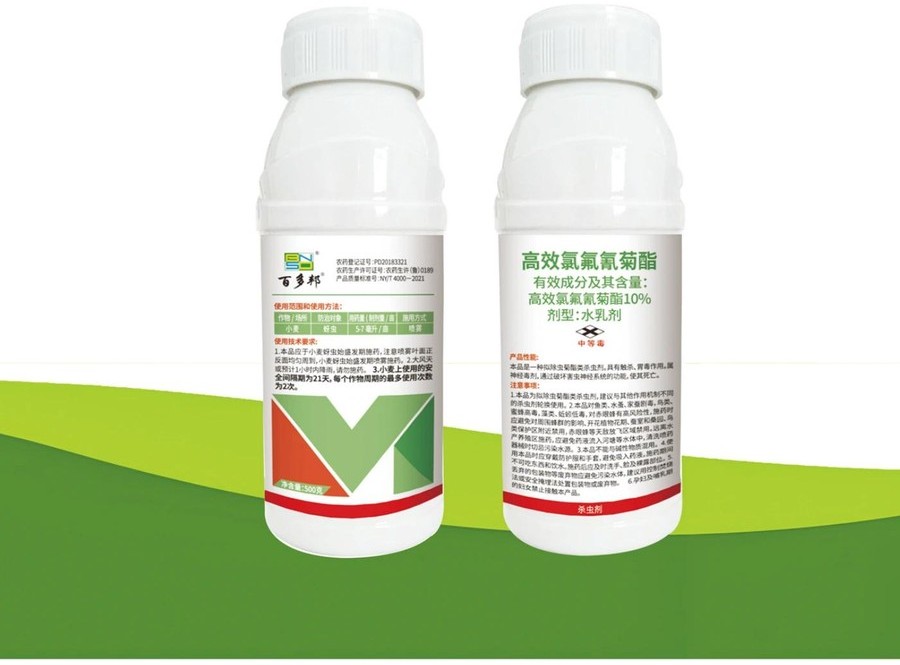
| 10% EW | Wheat aphids | 5–7 mL/667 m² | per contract |
All rates are Chinese registration label rates (667 m² = one mu ≈ 1/15 ha). Registration scopes and rates differ by country, so in your own market always follow the destination-market label.
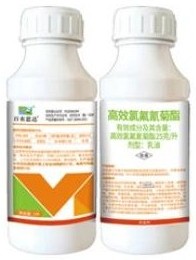
Reading the ladder: content up, dose down
The arithmetic is the first thing to internalise. At 25 g/L the label asks for 30–40 mL per mu; at 2.5% (essentially the same active concentration expressed by weight — see FAQ below) the band tightens to 20–30 mL; the 5% EW needs 10–20 mL; and the 10% EW covers wheat aphids at just 5–7 mL per mu. Every doubling of content roughly halves the dose, which means less pack volume, less freight and less shelf space per hectare treated. For a wholesale buyer, the 5% and 10% EW entries are the efficient end of the ladder; for a retail-facing importer, the low-content entries fit smallholder pack economics.
From EC to EW: why the newer registrations are water-based
The 25 g/L EC is a solvent-based emulsifiable concentrate: the classic system, robust and universally compatible with hand sprayers. The EW entries — emulsion-in-water — replace most of that organic solvent with water. The practical trade-offs are well established across the industry:
- Less solvent in the drum, which lowers odour, reduces the risk of phytotoxic reaction on sensitive foliage, and improves operator comfort in enclosed crops.
- Lower flammability in storage and transport, which simplifies dangerous-goods handling compared with solvent-heavy EC cargo.
- A formulation that demands more of the manufacturer: an EW only works if the emulsion droplets are milled and stabilised properly, so dispersion and long-term storage stability are the key checks when sourcing.
The 22% Thiamethoxam + Lambda-cyhalothrin Combo
At the top of the range sits a two-way combination suspension concentrate (SC): 22% thiamethoxam + lambda-cyhalothrin, marketed by BNSD Agro under the name “Ruika” (company information). The Chinese label covers wheat aphids at 5–7 mL/667 m² and tea leafhopper at 5–7 mL/667 m².
The logic of the pairing is straightforward. Thiamethoxam, an IRAC group 4A neonicotinoid, brings systemic uptake and residual control of sap-feeding pests; lambda-cyhalothrin, a group 3A pyrethroid, brings immediate contact kill and knockdown. One application, two unrelated modes of action — which is exactly the structure that rotation programs encourage. For buyers, a registered two-way combo also removes the guesswork of tank mixing two single products with different dose bases.
Rotating a Pyrethroid: IRAC 3A Discipline
Standard IRAC guidance for group 3A applies wherever lambda-cyhalothrin is used:
- Do not follow a group 3A application with another group 3A product against the same pest generation — cross-resistance within the pyrethroid group is well documented.
- Cap the number of 3A applications per crop cycle and rotate with unrelated modes of action — group 4A neonicotinoids, group 1 carbamates, group 6 avermectins, group 28 diamides, as registered locally.
- Where a pest is historically difficult — diamondback moth on brassicas is the classic example — pyrethroids should be one component of a program, not the whole program.
The 22% thiamethoxam + lambda-cyhalothrin SC fits this discipline: it delivers a 3A and a 4A in the same pass, so neither group is applied alone.
Matching Pack Sizes to Channels
The pack ladder mirrors the concentration ladder. The 25 g/L EC ships as 500 mL × 20 and 1 L × 12 — farm-gate bottles sized for knapsack sprayers. The 2.5% EW runs from a 75 g × 100 sachet box up to 1 kg × 12, with the sachet box designed for smallholder retail where each purchase is a pre-measured one- or two-mu job. The 5% EW starts at 200 g × 40 and climbs to 1 kg × 12. As a rule: sachets for retail, bottles for cooperatives and farm stores, and bulk packing for local formulators — confirm the full ladder in the supply contract before the season starts.
The full export range of insecticide and acaricide SKUs, including the complete lambda-cyhalothrin ladder and the 22% combo, is listed in the insecticides and acaricides catalogue. For samples, registration documents or OEM packing, contact BNSD Agro.
FAQ
Are 25 g/L EC and 2.5% EW the same strength?
Essentially yes — 25 g/L is the same active concentration as 2.5% expressed per unit volume. The difference is the formulation system: the EC carries the active in organic solvent, while the EW is an emulsion in water with a much lower solvent load. Because they are separate registrations, the label rate bands and pack ranges differ (30–40 mL vs 20–30 mL per mu against cabbage worm), so the destination-market label, not the arithmetic, decides how each product is positioned.
What is lambda-cyhalothrin used for on the Chinese labels?
Cabbage worm on brassicas is the registered target for the 25 g/L EC, the 2.5% EW and the 5% EW; wheat aphids are the registered target for the 10% EW. Beyond the single actives, the 22% thiamethoxam + lambda-cyhalothrin SC is registered against wheat aphids and tea leafhopper at 5–7 mL/667 m². Always follow the destination-market label in your own country.
How often can lambda-cyhalothrin be sprayed?
Treat it as a group 3A tool with a cap: limit the number of applications per crop cycle, never follow a 3A spray with another 3A product on the same pest generation, and rotate with unrelated IRAC groups. Pyrethroid resistance in pests such as diamondback moth is a documented reality, so the rotation is a commercial necessity, not a formality.
Which pack sizes should an importer choose?
Match the pack to the channel. The 75 g × 100 sachet box of the 2.5% EW suits smallholder retail; the 500 mL and 1 L bottles of the EC and EW range suit cooperative and farm-store channels; the high-content 10% EW is the lightest option per hectare for plantation-scale programs. Confirm the whole ladder — including any bulk drums — in the contract so the peak-season order lands in the packs your market actually sells.
WhatsApp / WeChat: +86 199 0636 5856