
Kasugamycin occupies a small but strategic corner of the fungicide market: it is one of the very few actives with registered credentials against both fungal disease — above all rice blast — and bacterial disease such as black rot and bacterial shot hole. For rice-growing markets, that dual profile makes it a mainstay product; for buyers, it makes the sourcing questions unusually concrete. This guide covers what kasugamycin is, the three formulations held by BNSD Agro (Shandong Bainong Sida Biotechnology Co., Ltd.) with their Chinese label rates, and the stewardship rules that keep an antibiotic useful. The full portfolio is on the fungicides catalogue, and enquiries go through the contact page.
What Is Kasugamycin?
Kasugamycin is an antibiotic fungicide–bactericide, discovered in the 1960s from a soil actinomycete of the genus Streptomyces. Chemically it is an aminoglycoside; functionally it inhibits protein synthesis in sensitive fungi and bacteria, a mode of action classified in FRAC group 24. Two properties define its field behaviour:
- Systemic movement. Kasugamycin is taken up and translocated within the plant, so it reaches tissue beyond the spray deposit — a meaningful advantage on rice, where dense canopies make thorough coverage difficult and where new leaves and tillers emerge continuously through the infection window.
- Dual activity, fungal and bacterial. Unlike most fungicides, kasugamycin is active on both kingdoms of plant pathogens. That is exactly what the Chinese registrations below exploit: a fungal target (rice blast), a bacterial target of leafy vegetables (Chinese cabbage black rot) and a bacterial orchard disease (peach bacterial shot hole).
Being a natural-product antibiotic also frames its main limitation: resistance is a live biological possibility, not a theoretical one, which is why the stewardship section below deserves the same attention buyers give to rates.
The Kasugamycin Range and Chinese Label Rates
| Product | Registered target (Chinese label) | Label rate |
|---|---|---|
| Kasugamycin 6% WP | Rice blast | 40–50 g/667 m² |
| Kasugamycin 6% WP | Chinese cabbage black rot | 25–40 g/667 m² |
| Kasugamycin 6% (HCl salt) SL | Rice blast | 40–50 mL/667 m² |
| 45% kasugamycin + oxine-copper SC | Peach bacterial shot hole | 2000–3000× dilution |
All rates are Chinese registration label rates (667 m² = one mu, about 1/15 hectare). Always apply destination-label guidance in your own market: registration scope and rates differ by country, and the table above positions the products rather than replacing your local label.
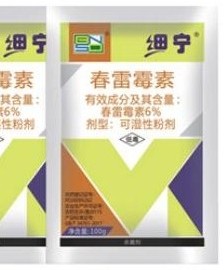
6% WP versus 6% SL: same active, two delivery formats
The two single-active products carry the same use rate against rice blast — 40–50 per 667 m² — but in different units, and the difference is deliberate. The wettable powder (WP) is dosed in grams and dissolves into the spray as a dispersion; it is the classic smallholder format, cheap to pack in sachets and stable in storage. The soluble liquid (SL) uses the hydrochloride salt of kasugamycin, dosed in millilitres, which dissolves completely in the tank with no residue on filters or screens — the format that suits cooperative sprayers and drone or low-volume programs where anything undissolved is a problem. Buyers serving both market segments therefore need both, not a choice between them.
The mixture: 45% kasugamycin + oxine-copper SC
The 45% SC pairs kasugamycin with oxine-copper, a copper-based compound of a different chemistry, and registers the combination against peach bacterial shot hole at 2000–3000×. The construction is standard bacterial-disease logic: the antibiotic acts systemically inside the plant, while the copper partner contributes contact activity on the surface. A mixture also cuts the resistance pressure on kasugamycin itself, since any resistant individuals face a second mode of action in the same pass. Buyers should note the label framing: the Chinese registration names peach bacterial shot hole, and bacterial-disease uses in other markets must be read from the destination label.
Resistance Stewardship: Treating an Antibiotic Like One
Kasugamycin’s mode of action — protein synthesis inhibition — is single-site, and antibiotics select for resistance as readily in plant pathogens as anywhere else. The standing stewardship guidance is short:
- Do not run kasugamycin back-to-back with itself. Rotate with fungicides and bactericides of unrelated modes of action across the crop cycle.
- Cap the number of applications per season; a rice program typically positions kasugamycin at the key blast windows rather than as an all-season repeat spray.
- Prefer mixtures where registered — the kasugamycin + oxine-copper SC is the built-in example — so that resistance to one partner is answered by the other.
- Watch efficacy season on season. A product that “suddenly stopped working” is usually telling a resistance story, and the response is program change, not dose escalation.
These are the same principles FRAC-type guidance applies to any single-site chemistry; with an antibiotic they are simply non-negotiable.
Positioning Notes for Buyers
Three practical points round out the picture. First, rice blast is the anchor use: in any market with blast pressure, the 6% WP and 6% SL are the volume products, with the WP serving sachet retail and the SL serving mechanised spraying. Second, the vegetable use — Chinese cabbage black rot at 25–40 g/667 m² — gives the WP a second season window outside rice. Third, pack formats matter for antibiotics: moisture protection drives the packaging spec for a WP, so confirm sachet quality and sealing with the supplier before committing to a tropical climate destination. BNSD Agro’s export pack ladder runs from retail sachets to 1 kg bags, and every batch is released against the registration standard by HPLC or GC before shipment (company practice). Product details are on the fungicides catalogue.
FAQ
What diseases is kasugamycin registered for?
On the BNSD Agro Chinese registrations: rice blast (6% WP at 40–50 g/667 m² and 6% SL at 40–50 mL/667 m²), Chinese cabbage black rot (6% WP at 25–40 g/667 m²) and peach bacterial shot hole (45% kasugamycin + oxine-copper SC at 2000–3000×). Destination-market labels govern elsewhere.
Is kasugamycin a fungicide or a bactericide?
Both. It is an antibiotic with activity against sensitive fungi and bacteria — which is why its registrations span a fungal disease (rice blast) and bacterial diseases (black rot, peach shot hole).
Why choose the 6% SL over the 6% WP?
The SL uses the hydrochloride salt and dissolves completely in the tank — no dispersion residue — which suits mechanised and low-volume spraying. The WP is the sachet-friendly classic for smallholder retail. Use rates against rice blast are equivalent at 40–50 per 667 m².
How should kasugamycin be rotated?
Like any single-site antibiotic: limit consecutive and total applications, rotate with unrelated modes of action, and use registered mixtures such as the kasugamycin + oxine-copper SC where available. Monitor field performance and change the program — not the dose — if efficacy slips.
WhatsApp / WeChat: +86 199 0636 5856