
Imidacloprid remains the most recognised name in the neonicotinoid family, and the enquiries it attracts fall into two very different camps: rice growers asking about planthopper programs, and specialty buyers surprised to learn it is registered for mushroom houses. Both answers live in the Chinese registrations held by BNSD Agro (Shandong Bainong Sida Biotechnology Co., Ltd.), where the molecule is carried by two workhorse formulations — a 10% WP and a 70% WDG. This guide walks through both, explains how the pack ladder serves very different channels, and closes with the stewardship rules that every group 4A buyer should be able to quote.
Imidacloprid Basics: IRAC Group 4A
Imidacloprid is a first-generation neonicotinoid classified in IRAC group 4A. Like all group 4A actives it binds to nicotinic acetylcholine receptors in the insect nervous system, and its commercial success rests on three properties:
- Systemic activity. The molecule is xylem-mobile: absorbed through roots or foliage, it moves upward into new growth, protecting tissue that develops after the spray.
- Contact and stomach action. Sucking pests die on contact with the deposit or while feeding on treated surfaces — the reason it performs against aphids, planthoppers, thrips and leafhoppers.
- Long residual control. Compared with pyrethroid-speed contact killers, a group 4A spray keeps working on new flush for days, which reduces the number of passes per season.
Mammalian toxicity is comparatively low — a well-established property of the group — but the environmental profile demands respect: 4A actives are highly toxic to bees and aquatic organisms, and pollinator timing is covered in the stewardship section below.
Imidacloprid 10% WP: One Formulation, Two Different Worlds
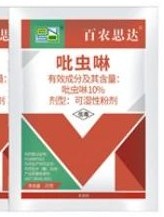
The wettable powder is the entry formulation for the molecule, and on the Chinese label it covers two registrations that could hardly be more different:
- Rice planthopper — 20–40 g/667 m², applied as a foliar spray directed at the base of the canopy where planthoppers congregate.
- Fungus gnat on mushroom beds — 1–2 g/m², an area-based rate for the growing medium rather than a field crop.
The mushroom registration deserves a note, because it is the one most buyers overlook. Fungus gnats breed in the moist substrate of mushroom beds, and a low-rate treatment of the medium targets the larvae where they live. Pack sizes for the 10% WP run from 10 g × 800 sachets — sized for smallholder use — up to 500 g × 20, covering both the retail counter and the mushroom-farm supply channel.
Imidacloprid 70% WDG: Cabbage Aphids at Gram-Level Doses
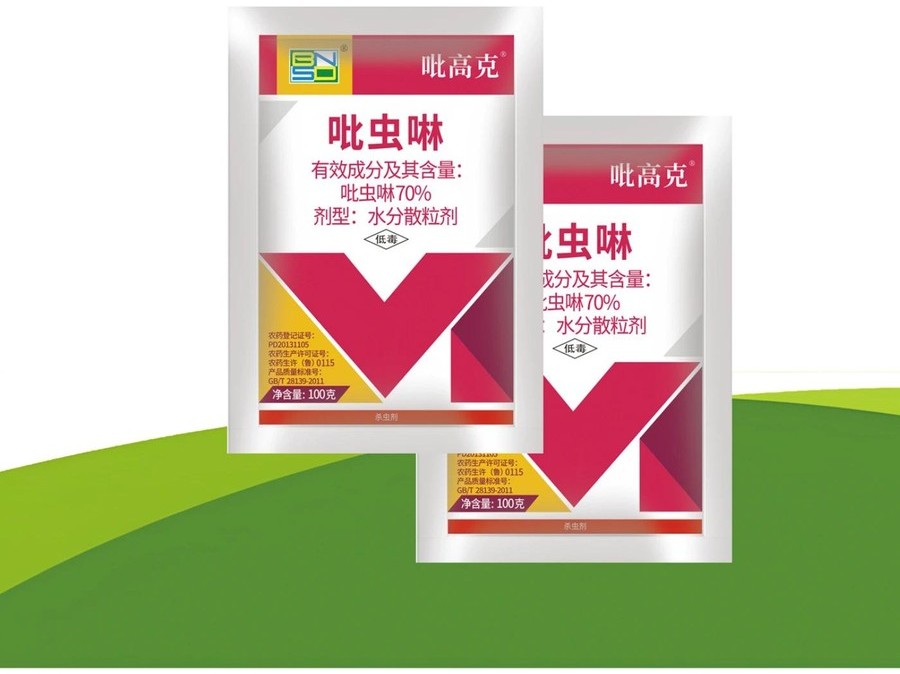
At the top of the foliar ladder sits the 70% water-dispersible granule, registered against cabbage aphids at 1.5–2 g/667 m². Read that again: one and a half to two grams of product per mu. A high-content WDG turns a full season of aphid control into a few handfuls of granules, which is precisely why the content matters commercially — freight per kilogram of active drops, and a single sachet covers the job.
The registered rate band also illustrates how content and dose interact. The 10% WP asks for 20–40 g per mu against planthopper; the 70% WDG asks for 1.5–2 g against cabbage aphids. Same molecule, tenfold difference per mu — driven both by the sevenfold content gap and by the different pest and crop. It is the clearest possible argument for letting the destination-market label, not a rule of thumb, decide positioning.
| Formulation | Registered use (Chinese label) | Label rate | Pack sizes |
|---|---|---|---|
| 10% WP | Rice planthopper | 20–40 g/667 m² | 10 g × 800 through 500 g × 20 |
| 10% WP | Fungus gnat on mushroom beds | 1–2 g/m² | 10 g × 800 through 500 g × 20 |
| 70% WDG | Cabbage aphids | 1.5–2 g/667 m² | 2 g × 1000 through 1 kg × 10 |
All rates are Chinese registration label rates (667 m² = one mu ≈ 1/15 ha). In your own market, always follow the destination-market label.
The Pack Ladder: From a 2 g Sachet to 1 kg
The pack sizes tell the channel story on their own. The 70% WDG begins at a 2 g × 1000 sachet box — one sachet is a one-mu dose of cabbage aphid control, pre-measured so the smallholder cannot under- or over-dose. The 10% WP starts even lower, at a 10 g × 800 sachet box. At the other end, both formulations close at the 500 g and 1 kg sizes that cooperatives and plantation buyers order by the pallet. This sachet-first, bulk-last ladder is the standard structure for high-content granule products: retail needs countable, tamper-evident units; wholesale needs freight-efficient bags.
Stewardship: Pollinator Timing and 4A Rotation
Two responsibilities come with every group 4A shipment:
Pollinator protection. Imidacloprid is acutely toxic to bees. Standard practice everywhere: never spray a flowering crop; spray in the evening when pollinators are least active; prevent drift to flowering weeds, field margins and neighbouring flowering crops; and follow the bee-protection provisions of the destination-market label. For the mushroom-bed use, the enclosure itself keeps the exposure profile different — but storage, disposal and container handling still deserve care around apiaries.
Rotation away from 4A. Neonicotinoid resistance is the most common reason a 4A product “stops working”. The IRAC rules are simple: do not follow a group 4A application with another group 4A product against the same pest generation, cap the number of 4A sprays per crop cycle, and rotate with unrelated modes of action — group 3A pyrethroids, group 1, group 6 or group 28 chemistries, as registered locally. Where planthopper or aphid populations are known to carry 4A resistance, position the product carefully and monitor field efficacy rather than defaulting to repeated sprays.
Both 10% WP and 70% WDG are listed in the insecticides and acaricides catalogue of BNSD Agro, alongside the rest of the neonicotinoid range. For samples, registration documents or OEM packing, contact BNSD Agro.
FAQ
What is the difference between imidacloprid 10% WP and 70% WDG?
Content, formulation system and — most importantly — the registered uses that come with each. The 10% wettable powder carries the rice planthopper and mushroom fungus gnat registrations; the 70% water-dispersible granule carries the cabbage aphid registration at a gram-level dose. They are not interchangeable: a higher content does not substitute for a different registered use, and the destination-market label decides positioning.
How much imidacloprid should be applied per mu?
On the Chinese labels described here: 20–40 g of the 10% WP for rice planthopper, 1–2 g/m² of the same product for fungus gnat on mushroom beds, and 1.5–2 g of the 70% WDG for cabbage aphids. Rates are property of the label — always transfer them from the destination-market label, not from this article.
Why is imidacloprid registered for mushroom beds?
Fungus gnat larvae develop in the moist growing medium of mushroom houses, and the medium is what the treatment targets — hence the area-based 1–2 g/m² rate rather than a per-hectare field dose. It is a niche but steady segment, and the 10 g sachet end of the pack ladder exists partly to serve it.
How can growers protect bees when spraying imidacloprid?
Never spray flowering crops; spray in the evening when pollinators are least active; avoid drift to flowering weeds and neighbouring crops; and follow the bee-protection statements on the destination-market label. Combined with a disciplined 4A rotation, this is the baseline stewardship package any professional buyer should expect to see communicated downstream.
WhatsApp / WeChat: +86 199 0636 5856