
Few herbicide enquiries are as location-specific as hexazinone. The buyers asking for it are almost never serving row crops; they are forestry agencies, plantation managers and municipal contractors who must keep firebreaks, forest roads and other non-crop land clear of vegetation before the dry season. For exactly that work, BNSD Agro (Shandong Bainong Sida Biotechnology Co., Ltd.) produces two registered formulations — a 5% granule for broadcast application and a 25% soluble liquid for spraying. This guide explains how the chemistry works, where each formulation fits, what the Chinese label rates are, and what an importer should verify before shipping. As throughout this series, the rates quoted are Chinese registration label rates; in your own market, the destination label always governs.
What Is Hexazinone?
Hexazinone belongs to the triazinone family of herbicides and acts as a photosynthesis inhibitor: once inside the plant it blocks electron transport at photosystem II, so treated vegetation can no longer sustain photosynthesis and declines over the following days and weeks. Three properties define its field behaviour:
- Dual uptake. Hexazinone enters plants through both the roots and the foliage, so it works whether the product is washed into the soil or deposited directly onto leaves.
- Upward transport. After root uptake it moves upward in the xylem — the water-conducting tissue — carrying the active ingredient into shoots and new growth.
- Soil residual, microbial breakdown. The compound persists in soil long enough to suppress regenerating weeds through a season, and it is ultimately degraded by soil microorganisms rather than by light or hydrolysis alone.
Put together, this is a vegetation-management profile: clear the existing growth, then hold the ground. That is precisely the job description of a firebreak treatment.
Two Formulations: 5% GR Broadcast and 25% SL Spray
The BNSD Agro registrations cover the same use — forest firebreak weeds — in two delivery formats (Chinese registration label rates; 667 m² = 1 mu ≈ 1/15 ha):
| Formulation | Application method | Label rate (per 667 m²) | Pack size |
|---|---|---|---|
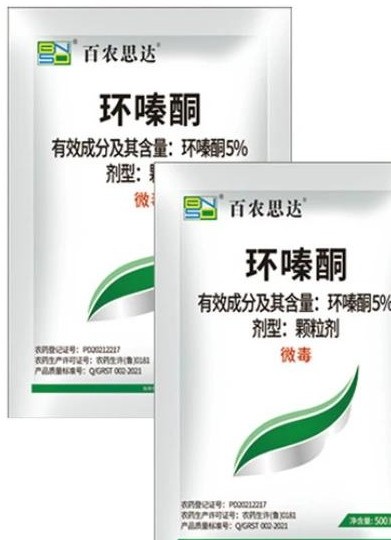
| Hexazinone 5% GR | Broadcast granule | 2–3 kg (≈ 30–45 kg/ha) | 500 g × 30 bags |
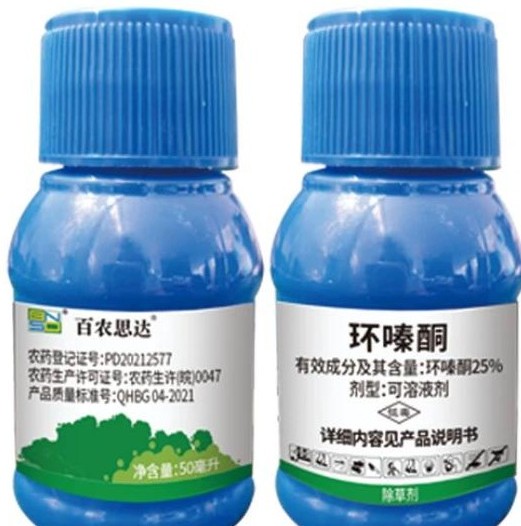
| Hexazinone 25% SL | Spray | 300–500 mL (≈ 4.5–7.5 L/ha) | 50 g × 100 bottles |
Where the granule fits
The 5% GR is the low-equipment option. Granules are broadcast by hand or with a simple spreader along the strip: no water to carry, no tank to mix, no nozzle calibration — which matters on steep slopes, in remote plantations and wherever labour is easier to find than functioning spray gear. Rainfall then moves the active into the root zone, where root uptake and xylem transport finish the job. For long, narrow strips treated ahead of the fire season, the granule is usually the most economical format in labour as well as in product.
Where the soluble liquid fits
The 25% SL suits operators who already run sprayers: forest roads passable by vehicle, perimeter strips around depots and nurseries, and band treatments where a targeted spray uses less product than broadcasting. A liquid also disperses into tank water at any ratio, giving crews flexibility in matching output to strip width. The trade-off is logistics — clean water, a serviced sprayer and operators who can hold a consistent swath.
Soil Behaviour and the Degradation Note
Because both formulations ultimately place the active in the soil, buyers should understand the residual side of the chemistry. Hexazinone’s persistence is governed mainly by microbial degradation: soils with active microbial populations break the molecule down over time, while cool, dry or biologically poor soils slow the process. Two practical consequences follow:
- On a firebreak, the residual is a feature, not a fault. Season-long suppression of regrowth is exactly what reduces the number of passes a crew must make before the dry season.
- The treated strip must be treated as non-crop land. Because of its soil activity, hexazinone ground must not be rotated into crops, and applications should be managed so run-off and the root zones of neighbouring desirable vegetation are not affected. Recropping and replanting intervals on the destination label are binding.
Safety Framing for Non-crop Use
Vegetation control along firebreaks happens in real landscapes — watersheds, boundaries, public land — so the safety conversation deserves as much space as the rate card:
- Non-crop use only. The Chinese registrations here cover forest firebreak weeds. At these rates hexazinone is not a cropland product, and off-label use on farmland or pasture is neither legal nor safe.
- Drift and run-off care. Leave buffer zones beside watercourses and crop boundaries, and avoid applying immediately before heavy rain, which can move surface-applied granules or fresh spray deposits downslope.
- Operator protection. Standard label PPE applies for both spreading and spraying; handle granules in a way that limits dust, and store packs away from feed, seed and food.
- Label compliance. Rates, protective equipment and environmental precautions must follow the destination-market label, which may be stricter than the source label.
What Importers Should Check Before Ordering
Hexazinone is not a high-volume commodity chemistry, so document discipline matters more than marginal price:
- Registration and licence match. The Chinese pesticide registration certificate and production licence should be held in the supplier’s own name and match the formulation and content offered.
- Batch COA. Every batch should ship with a certificate of analysis; declared content (5% or 25%) is a registered value, not a marketing range.
- Formulation quality. For the GR: free-flowing, dust-limited granules that survive compression in the bag. For the SL: complete dissolution in water with a clear solution and no sediment.
- Pack integrity. The 500 g bags and 50 g bottles must arrive sealed and correctly labelled, in packaging that survives the humidity of the destination, not only the dry container.
- Export documentation. Confirm the dangerous-goods classification and required shipping documentation for the specific product early, so paperwork is not the bottleneck at booking time.
The full export range is listed in the herbicides catalogue. For registration documents, samples or OEM packing, contact BNSD Agro.
FAQ
What is hexazinone used for?
On BNSD Agro’s Chinese registrations, hexazinone is registered for forest firebreak weed control in two formats: 5% GR broadcast at 2–3 kg/667 m² and 25% SL sprayed at 300–500 mL/667 m². It is a non-crop vegetation-management use; always follow the destination-market label for authorized uses and rates in your country.
Should I stock the granule or the soluble liquid?
Follow the customer’s application method. Crews treating steep or remote firebreaks by hand or spreader, with no reliable water source, need the 5% GR. Operators with sprayer infrastructure treating vehicle-accessible strips order the 25% SL. Many distributors stock both, because terrain within a single province can demand both formats.
How long does hexazinone persist in the soil?
Persistence is governed mainly by microbial degradation and therefore varies with soil temperature, moisture and biological activity — which is why no single figure fits every site. Plan on an extended residual relative to purely foliar herbicides, manage the strip as non-crop land for the season, and follow the recropping intervals on the destination label.
Can hexazinone be used on farmland or pasture?
No — not under the registrations discussed here. The Chinese label use is forest firebreak weed control, and the product’s soil residual makes crop injury likely if applied to land intended for crops. Off-label use exposes the user to both legal and agronomic risk.
WhatsApp / WeChat: +86 199 0636 5856