
A protected crop lives in the best weather it will ever get: steady temperatures, no rain, no wind, a long season. Unfortunately, so do its pests. The same still, humid air that the crop converts into yield also converts into downy mildew colonies, grey mould on senescing petals and whitefly generations cycling every few weeks. Protected cropping therefore cannot be run as a sequence of emergency sprays; it needs a program built around the structure’s own microclimate.
This guide sets out the pressure triangle inside a greenhouse, and a three-front response built on the Chinese registration labels held by BNSD Agro (Shandong Bainong Sida Biotechnology Co., Ltd.): dimethomorph 80% WDG for downy mildew, pyrimethanil 80% WDG for grey mould, and bifenthrin 2.5% EW for whitefly.
The Protected-Crop Pressure Triangle
Three pressures feed on one another in an enclosed house:
- Humidity-driven foliar diseases. Downy mildews and Botrytis need film water or saturated air to infect. A closed house gives them both — especially overnight and in the hour after sunrise, when the crop’s own transpiration condenses on cold plastic.
- Vectors. Whitefly, thrips and aphids breed continuously in a stable climate. Beyond the direct sap loss and honeydew–sooty mould damage, several of them transmit viruses, so a “small” vector population becomes a disease problem weeks later.
- Root-zone stress. Continuous cropping, tight rotations and overwatering in heavy substrate stress the root system; a stressed crop is a softer target for every foliar problem above it.
The triangle matters because each front amplifies the others: dense canopies hold humidity, humidity favors disease, diseased tissue shelters more vectors. A greenhouse disease management plan that treats only one front keeps losing to the other two.
Front One: Downy Mildew — Dimethomorph 80% WDG
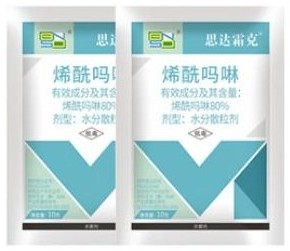
Downy mildews are oomycetes — water moulds, not true fungi — which is why many broad-spectrum products barely touch them and a specialist is required. On the Chinese registration label held by BNSD Agro, dimethomorph 80% water-dispersible granule (WDG) is registered against cucumber downy mildew at 20–25 g/667 m² (667 m² = one mu ≈ 1/15 ha).
Dimethomorph belongs to FRAC group 40, acting on cell-wall synthesis in the oomycete — a mechanism unrelated to the respiration inhibitors and phenylamides also used against this family, which is what makes it valuable in rotation. It combines protectant activity with curative reach and strong anti-sporulation effect, so a well-timed pass stops an established lesion from seeding the next cycle. In a house where downy mildew rebounds with every humid night, timing at first appearance and complete leaf coverage decide the outcome.
Front Two: Grey Mould — Pyrimethanil 80% WDG
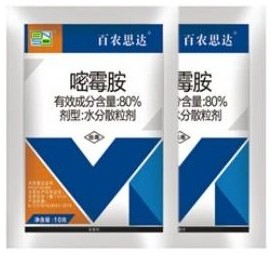
Grey mould is the disease that defines protected cropping: Botrytis cinerea lives on senescing petals, pruning wounds and dying leaf margins, and explodes wherever still humid air meets wounded tissue. On the Chinese registration label, pyrimethanil 80% WDG is registered against cucumber grey mould at 30–45 g/667 m².
Pyrimethanil is an anilinopyrimidine (FRAC group 9) and a Botrytis specialist rather than a broad-spectrum product. Its properties fit the enclosed house well — including a volatility profile that lets deposited active reach neighbouring tissue inside a dense canopy, which is exactly where spray droplets from outside struggle to land. Position it at the flowering and first-infection window, ahead of symptom build-up; a grey mould program that waits for the grey dust is already a rescue operation.
Front Three: Whitefly — Bifenthrin 2.5% EW
Whitefly is the vector that most often breaks a protected program: adults fly in clouds when disturbed, nymphs sit under leaves where sprays miss them, and every life stage overlaps within a few warm weeks. On the Chinese registration label, bifenthrin 2.5% EW is registered against whitefly on tomato at 30–40 mL/667 m².
Bifenthrin is a synthetic pyrethroid (IRAC group 3A) acting by contact and stomach action; its fast knockdown of mobile adults is what removes a generation before it lays the next batch of eggs. The formulation is chosen deliberately: an EW (oil-in-water emulsion) carries the active in small oil droplets dispersed in water instead of the heavy organic-solvent load of a classic EC — a lower-solvent profile that is gentler in enclosed houses and generally softer on sensitive crops under plastic. Coverage decides the rest: whitefly control lives under the leaf, so the sprayer must be directed there.
Humidity and Ventilation Management
No label rate fixes a house that stays wet. The husbandry that makes the three-front chemistry work is standard protected-cropping practice:
- Vent to break the humidity spikes — overnight and after sunrise, when condensation forms on cold surfaces; even short ventilation events reset the infection clock.
- Water early in the day and at the root zone, so the canopy dries before nightfall; drip lines beat overhead wetting.
- Train, prune and thin the canopy for airflow, and strip senescing leaves before they become Botrytis fuel.
- Remove infected tissue from the house, sealed and discarded — not into a corner where sporulation continues.
- Scout under leaves weekly so vector populations are counted before they are visible in clouds.
Rotation in Protected Systems
A greenhouse compounds resistance risk the same way it compounds everything else: crop follows crop with no winter break, and the pathogen population never resets. The rotation rules that follow are standard practice:
- Alternate FRAC groups across the season — dimethomorph is group 40, pyrimethanil is group 9; do not follow one group with itself, and cap the number of applications of each group per crop cycle.
- Anchor with multi-site products where the destination label provides them — materials with no meaningful resistance risk take pressure off the specialists.
- Rotate IRAC groups for vectors — bifenthrin (IRAC 3A) is a knockdown tool, not a season-long solo program; alternate with unrelated modes and respect label limits on pyrethroid use frequency.
- Keep records. In a house that grows three crops a year, “what did we spray last cycle” is a resistance-management question, not a memory exercise.
The Three Fronts at a Glance
| Front | Product | Chinese label rate | Registered use (China) | Mode-of-action class |
|---|---|---|---|---|
| Humidity diseases — downy mildew | Dimethomorph 80% WDG | 20–25 g/667 m² | Cucumber downy mildew | FRAC 40, oomycete specialist |
| Humidity diseases — grey mould | Pyrimethanil 80% WDG | 30–45 g/667 m² | Cucumber grey mould | FRAC 9, Botrytis specialist |
| Vectors — whitefly | Bifenthrin 2.5% EW | 30–40 mL/667 m² | Whitefly on tomato | IRAC 3A pyrethroid, knockdown |
All rates are Chinese registration label rates; 667 m² equals one mu, roughly 1/15 hectare. Registered crops, doses and use patterns differ by country — the destination-market label always governs before positioning or applying stock.
Building the Program
The fungicide front (dimethomorph, pyrimethanil) sits on the fungicide catalogue, the vector front (bifenthrin 2.5% EW) on the insecticide catalogue; for label documents, samples or a protected-cropping program assembled for your market, contact the export team.
FAQ
What is dimethomorph 80% WDG registered for?
On the Chinese registration held by Bainong Sida: cucumber downy mildew at 20–25 g/667 m². Dimethomorph is an oomycete specialist (FRAC group 40) combining protectant, curative and anti-sporulation activity; which uses apply in your market is decided by the destination label.
What rate does pyrimethanil 80% WDG use against grey mould?
The Chinese label rate is 30–45 g/667 m² on cucumber grey mould. Pyrimethanil is an anilinopyrimidine Botrytis specialist (FRAC group 9) best positioned at the flowering and first-infection window; destination-market registration and rates govern elsewhere.
Why choose an EW formulation for whitefly control inside a greenhouse?
An EW (oil-in-water emulsion) carries bifenthrin in small oil droplets dispersed in water rather than a heavy organic-solvent load. Inside an enclosed house that means less solvent odour for workers, less risk to sensitive crops under plastic, and the same contact knockdown (IRAC 3A) against mobile whitefly adults.
How should chemistry be rotated across a protected season?
Alternate unrelated groups: FRAC 40 (dimethomorph) and FRAC 9 (pyrimethanil) each capped per crop cycle, multi-site anchors where the destination label provides them, and IRAC rotation on the vector front so a pyrethroid like bifenthrin is a knockdown tool within a rotation rather than a repeat solo program. With several crops a year in the same house, written spray records are part of resistance management.
WhatsApp / WeChat: +86 199 0636 5856