
Glyphosate has been the default non-selective herbicide of global agriculture for decades, and glufosinate is the alternative that buyers increasingly ask about — particularly in markets where glyphosate-resistant weeds are no longer news but routine. Because the two actives are compared constantly, the comparison itself needs care: one disclosure comes first. BNSD Agro (Shandong Bainong Sida Biotechnology Co., Ltd.) manufactures glufosinate and sells no glyphosate — the company states this plainly, so everything below about glyphosate is well-established, industry-wide general knowledge, while product specifics come only from the glufosinate-P registration on file.
Two Different Modes of Action
The two molecules shut weeds down through entirely different biochemistry — this part is general plant-physiology knowledge, not a product claim:
- Glyphosate inhibits EPSPS (5-enolpyruvylshikimate-3-phosphate synthase), an enzyme of the shikimate pathway that plants need to build aromatic amino acids. The block is lethal, but it takes time to express: glyphosate is genuinely systemic, translocating from treated foliage down into roots and rhizomes, and the plant declines over days to weeks. It is classified in HRAC group 9.
- Glufosinate inhibits glutamine synthetase (GS). Ammonia accumulates in the tissue, photosynthesis stalls, and the plant burns down quickly — a contact kill with only partial translocation, and a visual response measured in days rather than weeks. It is classified in HRAC group 10.
Different enzyme targets mean no cross-resistance between the two, which is precisely why the pair matters in resistance management: where glyphosate-resistant populations are widespread, glufosinate is one of the standard alternative modes of action a program can rotate to.
Practical Differences in the Field
| Aspect | Glufosinate | Glyphosate |
|---|---|---|
| Mode of action | Glutamine synthetase inhibitor (HRAC 10) | EPSPS inhibitor (HRAC 9) |
| Movement in the plant | Contact burn-down, partial translocation | Fully systemic, down to roots and rhizomes |
| Symptom speed | Fast — visible burn-down within days | Slower — complete kill takes longer |
| Root kill | Top growth controlled; perennials can regrow from below | Kills roots and rhizomes of treated plants |
| Resistance situation | Favoured where glyphosate resistance exists | Resistance widespread in major weed species |
| Typical use windows | Pre-plant burn-down, orchard and vineyard rows, non-crop areas | Broad pre-plant and in-crop (traited systems) use |
Three practical readings of that table:
Speed. Glufosinate’s contact burn-down shows itself fast, which matters in short turnaround windows — clearing a field between harvest and the next sowing, or cleaning orchard rows ahead of harvest or visitor traffic. Glyphosate needs longer to express but finishes the job below ground.
Root kill versus regrowth. Glyphosate’s systemic movement is the agronomic advantage on perennial weeds — where the root and rhizome are killed, the problem does not return from below. Glufosinate controls the top growth; heavy perennial pressure calls for integrated programs and repeat management rather than a single substitution.
Resistance rotation. With glyphosate-resistant biotypes widespread in key weed species, programs increasingly alternate HRAC group 9 and group 10 actives — and the durable answer is to rotate among genuinely different mechanisms (including residual pre-emergent partners) rather than leaning on any single non-selective.
Glufosinate-P 10% SL: The BNSD Agro Registration
The BNSD Agro product (company information) is 10% glufosinate-P — the refined R-isomer ammonium salt, formulated as an SL (soluble liquid). Glufosinate is a chiral molecule with two stereoisomers, and the R-isomer is the one carrying most of the herbicidal activity; refining the active isomer means more of what is in the pack does the work.
- Registered use (Chinese label): non-crop areas and orchard rows at 200–400 mL per 667 m² (667 m² = one mu, 1/15 ha). As with every rate quoted here, follow the destination-market label — registered crops, targets and rates differ between countries.
- Packs: 100 g × 100 sachets and 1 kg × 12 bottles, a ladder that covers smallholder retail through farm-scale spraying.
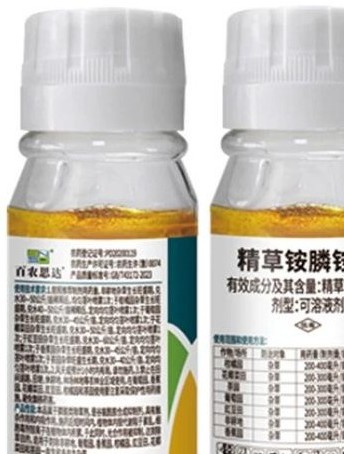
Buyers who need both actives should note the disclosure above: BNSD Agro sells no glyphosate, so this article does not offer a branded glyphosate alternative — only the chemistry context in which glufosinate-P is positioned.
Follow-Up Selective Options in the Same Catalogue
Burn-down clears the field; in-season weed control then needs selective actives. Alongside the glufosinate-P registration, the herbicide list on file includes:
- Fluroxypyr 200 g/L emulsifiable concentrate (EC) — broadleaf weeds in winter wheat;
- Florasulam + MCPA 40% suspension concentrate (SC) — broadleaf spectrum in winter wheat;
- Haloxyfop-P-methyl 108 g/L EC — grass weeds in cotton.
The logic is a relay: a non-selective pass for clean-up and row management, then selective products matched to the crop and weed spectrum, each on its own registration and each used per the destination-market label.
Sourcing Notes for Importers
For buyers evaluating a glufosinate-P 10% SL supplier, the checks that matter:
- Documents in the manufacturer’s name. Pesticide registration certificate and production licence held by the producing entity — not a trading intermediary.
- Batch COA against the registered content. Every batch should ship with a certificate of analysis matching the declared 10%, consistently across batches.
- SL physical quality. A soluble liquid should be a clear, homogeneous solution with no sediment, and must not crystallise or separate after cold storage — a simple but revealing test.
- Pack ladder. Confirm the 100 g sachet to 1 kg bottle range and packaging material in the contract before committing volumes.
- Label alignment. Rates quoted in China (200–400 mL/667 m² here) are Chinese registration label rates; the destination-market label governs in your market.
The full herbicide range of 6 export SKUs is listed in the herbicides catalogue. For samples, registration documents or a quotation, contact BNSD Agro.
FAQ
Is glufosinate systemic like glyphosate?
No — and this is the core practical difference. Glufosinate is a contact burn-down with only partial translocation, which is why its visual response is faster. Glyphosate is genuinely systemic and moves into roots and rhizomes. Follow the destination-market label for registered uses in your market.
Why do buyers consider glufosinate where glyphosate resistance exists?
Because the two act on entirely different enzymes — glutamine synthetase (HRAC 10) versus EPSPS (HRAC 9) — there is no cross-resistance between them. In markets where glyphosate-resistant biotypes are widespread, glufosinate is one of the standard alternative modes of action for rotation.
What is glufosinate-P?
The refined single-isomer form: glufosinate has two stereoisomers, and the R-isomer carries most of the herbicidal activity. BNSD Agro’s registration is a 10% refined R-isomer ammonium salt SL, which means more of the active in every litre is the working isomer.
Does BNSD Agro sell glyphosate?
No. The company states plainly that it has no glyphosate product; the glyphosate half of the comparison in this guide is general industry knowledge, and buyers needing glyphosate should source it elsewhere.
What is the label rate for glufosinate-P 10% SL?
On the Chinese registration: 200–400 mL per 667 m² in non-crop areas and orchard rows. Rates, crops and targets differ between countries — always follow the destination-market label.
WhatsApp / WeChat: +86 199 0636 5856