
Few products attract as much loose talk as humic substances, and few reward a close reading of the specification sheet as much. Fulvic and humic acids come from the same family of soil-derived organic molecules, but they are not interchangeable: one is small and plant-active, the other large and soil-active. Mineral-source potassium fulvate puts the plant-active fraction to work while carrying a meaningful potassium load — which is why it appears in root-development, stress-recovery and soil-conditioning programs alike. This guide separates fulvic from humic, explains what “mineral-source” means for consistency, and sets out the specification of the BNSD Agro (Shandong Bainong Sida Biotechnology Co., Ltd.) grade.
Fulvic vs Humic: Same Family, Different Jobs
Humic substances are the stable end-products of long-term decomposition of plant residue — the chemistry of mature soil organic matter. Within that family, the two fractions differ mainly in molecular size, and size decides where each one works:
- Fulvic acid is the lowest-molecular-weight fraction. It stays soluble across the whole pH range, moves readily into plant tissue, and is the fraction agronomists associate with plant-level activity: root initiation, nutrient carriage inside the plant, help through stress windows.
- Humic acid is the larger fraction. It is less mobile and works mostly where it lands — in the soil — improving structure, cation exchange capacity and the retention of nutrients around the root zone.
A product that declares both fractions, as this one does, therefore works at both levels: the fulvic fraction carries the in-plant role, the humic fraction carries the soil role. That division of labour is the general understanding of the category and the reason the two names appear together on serious specification sheets.
Why “Mineral-source” Matters
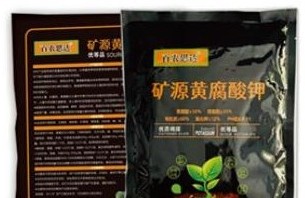
The words on the front of the bag answer a consistency question. Fulvate products are made either from mineral raw material — typically oxidized lignite or leonardite, ancient plant matter that has already decomposed in the ground — or from biological fermentation byproducts. The mineral route is the established one for defined fulvate specifications: the raw material is millions of years old, its composition is stable batch to batch, and the declared fulvic, humic and organic-matter figures can be checked against a certificate of analysis.
For a buyer, that translates into one sentence of advice: when a supplier says “mineral-source”, ask for the analysis that proves the declared percentages — and expect the same numbers to arrive in every container.
The Specification on the Bag
The BNSD Agro mineral-source potassium fulvate is packed in 1 kg bags, 10 bags per carton, and declares:
- Fulvic acid ≥50%
- Humic acid ≥55%
- K₂O ≥12%
- Organic matter (OM) ≥60%
Two things about that list deserve attention. First, the two fractions are declared separately — a spec that quotes only “humic” may or may not contain meaningful fulvic, the fraction that does the in-plant work. Second, the K₂O line is not decorative: because the molecule is carried as potassium fulvate, every pass adds a modest, fully soluble potassium supply on top of the organic function — potassium being exactly the element the crop leans on during fruit fill and stress.
Four Benefit Areas
Agronomists generally group potassium fulvate’s effects into four areas, which is also the order in which a grower tends to observe them:
- Roots. The fulvic fraction is associated with root initiation and elongation. In practice this shows up after transplanting and at the first fertigation passes: a denser, whiter root run that lifts water and nutrient uptake for the rest of the cycle.
- Stress support. Across cold snaps, heat spells and salinity pressure, humic-substance products are widely used to help the crop hold on — maintaining uptake and metabolic activity while conditions are unfavourable, then speeding the return to normal growth once they ease.
- Soil conditioning. The humic fraction works on the soil itself: better aggregation, higher exchange capacity, and a root zone that holds nutrients instead of letting them leach. This is the slow, compounding benefit — the one that shows over seasons of use.
- Nutrient efficiency. Humic substances bind and release nutrients in the root zone and help carry micronutrients into the plant, so a program built on fulvate typically squeezes more from every kilogram of fertilizer applied with it.
None of these are single-application miracles; they are the reasons the product sits in a season-long program rather than beside it.
Use Notes
- All three routes work. Drip and drench put the product where the soil conditioning happens; foliar passes lean on the fulvic fraction’s mobility. Follow the label rate and interval for the product and crop.
- It dissolves completely. The grade is fully water-soluble for fertigation, but as with any organic concentrate, prepare the stock solution properly and keep the line filtered.
- Jar-test before new tank mixes. Fulvate mixes broadly with mainstream feeds and pesticides, but concentrated calcium and strongly acidic mixes deserve a compatibility check first.
- Potassium counts toward the program. With K₂O at ≥12%, every pass contributes potassium; account for it in the season’s K budget rather than treating it as a free extra.
- All rates above follow the product specification for the Chinese market (667 m² = one mu, ≈ 1/15 ha). Adjust to crop, water analysis and destination-market guidance.
The fulvate sits in the BNSD Agro nutrition line — see the nutrition products page. For specifications, samples or OEM packing, contact BNSD Agro.
FAQ
What is the difference between fulvic acid and humic acid?
Molecular size. Fulvic acid is the small, soluble-at-any-pH fraction that moves into plant tissue and drives the in-plant effects — root support, stress support, nutrient carriage. Humic acid is the larger fraction that stays in the soil and improves structure and nutrient retention. A serious product declares both.
Why does “mineral-source” matter when buying fulvate?
Mineral-source products come from oxidized lignite or leonardite, whose composition is stable, so the declared fulvic, humic and organic-matter percentages hold batch after batch. Fermentation-derived products vary more in composition, which makes the specification harder to verify against a certificate of analysis.
Is the K₂O in potassium fulvate enough to replace potassium fertilizer?
No. At ≥12% K₂O, the product contributes a real but modest potassium supply alongside its organic function. The season’s main potassium still comes from the NPK program; the fulvate’s potassium is a supplement that should simply be counted in the budget.
Which application route should I choose — drip, drench or foliar?
Drip and drench deliver the soil-conditioning benefit directly to the root zone and suit scheduled fertigation passes. Foliar spray leans on the fulvic fraction’s plant mobility and suits stress-recovery moments. Many programs use both: fertigation as the base, a foliar pass before or after stress windows, following the label rate.
WhatsApp / WeChat: +86 199 0636 5856