
By the time the first mildewed shoot appears in spring, most of an orchard’s season has already been decided. The diseases and pests that flare between flowering and harvest do not arrive with the warm weather — they spent the winter in the orchard, inside buds, under bark scales, in leaf litter and mummified fruit. A dormant spray is the one pass of the year aimed directly at that overwintering population, and the lime sulphur winter wash is its classic tool.
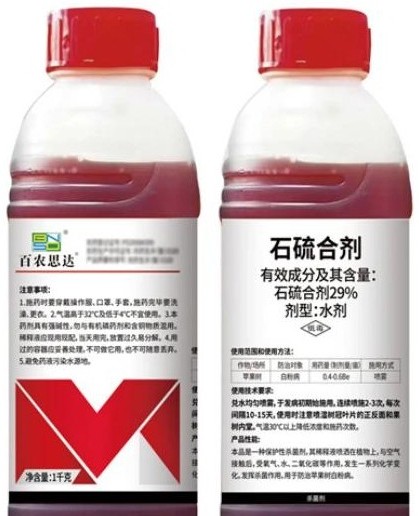
This guide explains why the dormant window matters, how the lime sulphur 29% aqueous solution (AS) held by BNSD Agro (Shandong Bainong Sida Biotechnology Co., Ltd.) sits on its Chinese registration label, the timing and technique rules that keep the spray safe, and the orchard winter cleanup work that surrounds it.
Why Dormant-Season Sprays Matter
An orchard that looks clean in January rarely is. Well-established overwintering biology means a dormant block typically carries:
- Powdery mildew mycelium inside infected buds — on apple, the fungus survives the winter within bud scales and emerges with the new shoot, which is why infections appear on the first leaves rather than arriving from outside.
- Spores in leaf litter and mummified fruit — the inoculum that starts scab, brown rot and related spring cycles.
- Cankers and dead wood — localized sources of spore-producing tissue through the wet season.
- Sedentary pests — overwintering mite eggs, scale insects and aphid eggs sheltered on bark and spurs.
Every one of these populations multiplies from a starting point. The logic of the dormant spray is to shrink that starting point before any green tissue exists — so that in-season fungicides and insecticides begin the season against lower pressure instead of playing catch-up. Dormant-season work is also the safest window of the whole year: no open flowers, no fruit, no pollinators and no harvest interval to manage.
The Registered Anchor: Lime Sulphur 29% AS
Lime sulphur is a solution of calcium polysulphides — an inorganic, multi-site material with a long history in tree fruit. On the Chinese registration label held by BNSD Agro, lime sulphur 29% AS is registered on apple against powdery mildew at 0.4–0.6 °Bé, applied as an overwintering cleanup spray during dormancy.
The concentration matters. The Baumé (°Bé) reading is taken on the diluted spray liquid, so the 0.4–0.6 °Bé range translates into a specific dilution of the 29% stock — a light but genuine dose that suppresses overwintering inoculum on wood and buds without waiting to injure tender tissue, because there is none yet. Because it is a multi-site contact material with no meaningful resistance risk, lime sulphur is the dependable anchor of a dormant program: it does cleanup work that newer, resistance-prone molecules would otherwise be asked to do in-season.
Timing: Dormant Stage Only
The registration and the biology point to the same window: the dormant stage only, after leaf fall and before bud break. The spray must be finished while the tree is still fully dormant, because lime sulphur is caustic to actively growing tissue — as buds swell, open and show green, the same dose that was safe in January burns the crop.
Within that window, choose the application day as carefully as the week:
- Avoid high-temperature windows. Sulphur materials turn injurious in heat; the label caution against high-temperature application applies to lime sulphur as much as to any sulphur product. Spray on a cool, calm day.
- Avoid freezing conditions. Sprays that dry onto wood in frost can mark bark and buds; let hard freezes pass.
- Allow a generous interval around oil sprays. Never mix lime sulphur with mineral oil or any other pesticide — and where an oil spray has been or will be applied to the same block, keep the two well separated in time, per the destination label.
Technique: Getting the Winter Wash Right
A winter wash is a coverage job more than a volume job:
- Dilute to the label concentration. Target 0.4–0.6 °Bé in the tank on apple, checked with a Baumé or conductivity reading rather than guessed.
- Wet the wood thoroughly. Trunks, limbs, spurs and bud clusters must be covered to the point of runoff — the target lives on the surface of the wood, not inside it.
- Work from the top down so drift does not leave untreated upper wood, and overlap rows slightly on dense canopies.
- Spray alone. Lime sulphur is strongly alkaline and must never be tank-mixed with other pesticides: combinations can invert chemically, lose efficacy or injure bark. One product, one pass.
- Clean equipment after use, since residues of the alkaline solution can affect the next load.
The Orchard Winter Cleanup Checklist
The winter wash works best as one layer of a full orchard winter cleanup. A block that is pruned, picked clean and washed starts the season with dramatically less carry-over pressure:
| Cleanup task | What it removes | Why it matters |
|---|---|---|
| Winter wash: lime sulphur 29% AS, 0.4–0.6 °Bé, dormant | Overwintering inoculum on bark, spurs and buds | Cuts starting pressure before green tissue appears |
| Prune out mildewed shoots and cankered wood | Bud-borne mildew and canker margins | Removes inoculum no spray can reach |
| Rake and destroy fallen leaves and mummified fruit | Litter- and fruit-borne spores | Breaks the carry-over between seasons |
| Clear pruning debris from rows and headlands | Shelter for pests and splash-dispersed inoculum | Speeds drying and improves spray coverage |
| Service and calibrate the sprayer | Uneven deposits and blockage risk | Ensures every later spray lands where aimed |
Prunings and litter should leave the block — chipped, buried or burned where local rules allow — because debris left between the rows simply re-arms the orchard.
Where the Winter Wash Fits the Season
The dormant pass is not a substitute for the season’s program; it is the foundation under it. On apple, a clean start lets the spring and summer fungicide rotations begin against lower mildew pressure. The full crop-protection range behind that program sits on the fungicide catalogue; for rates on a destination label, samples or registration documents, contact the export team.
All rates in this guide are Chinese registration label rates. Registered crops, doses and timings differ by country — always follow the destination-market label before positioning or applying stock.
FAQ
What does a dormant spray do on fruit trees?
It targets the pests and pathogens overwintering in the block — bud-borne mildew mycelium, litter-borne spores, scale insects and mite eggs on bark — before any green tissue exists. Cutting that starting population in winter means every in-season spray works from lower pressure, and the most sensitive window of the crop (bloom to harvest) is left untouched.
What rate should a lime sulphur winter wash use on apple?
On the Chinese registration label held by Bainong Sida, lime sulphur 29% AS is registered on apple against powdery mildew at 0.4–0.6 °Bé as an overwintering cleanup spray, applied during dormancy. The Baumé reading is taken on the diluted spray, and the destination-market label governs both the dilution and the permitted uses in your own market.
Can lime sulphur be mixed with other pesticides or spray oils?
No. Lime sulphur is strongly alkaline and must never be tank-mixed with other pesticides, and it must be kept well separated in time from mineral oil sprays — the combination is a classic cause of tree injury. Treat it as a solo pass in the dormant window and follow the interval to adjacent sprays stated on the destination label.
When is the right time to spray — and when is it too late?
Right time: full dormancy, after leaf fall and before bud break, on a cool, calm, dry day with no frost and no high-temperature window. Too late: once buds swell and green tissue shows — the caustic solution that was a cleanup spray on dormant wood will burn developing buds and shoots.
WhatsApp / WeChat: +86 199 0636 5856