
Among the herbicides a Chinese manufacturer ships for winter wheat, fluroxypyr occupies a specific slot: it is the auxin-type product growers reach for when broadleaf weeds are the problem and the cereal must come through unharmed. BNSD Agro (Shandong Bainong Sida Biotechnology Co., Ltd.) produces fluroxypyr 200 g/L EC registered for annual broadleaf weeds in winter wheat, including the species that cause the most complaints from wheat buyers in Asia and the Middle East. This guide covers how the molecule works, the Chinese label rate, field timing, tank-partner considerations and the checks a buyer should run before placing a bulk order. Rates here are Chinese registration label rates; the destination-market label governs in your own country.
What Is Fluroxypyr?
Fluroxypyr is a pyridine herbicide that mimics plant auxin — the growth hormone plants use to coordinate development. That “auxin mimic” classification explains everything observable in the field:
- Systemic movement. Absorbed mainly through foliage, the active translocates through the weed’s vascular system to growing points and roots, so the whole plant collapses, not just the sprayed surface.
- Characteristic symptom sequence. Treated broadleaf weeds twist, curl and cup; new growth becomes abnormal; the plant exhausts itself and dies over one to three weeks. Growth stops within hours of treatment, which is why the crop stops competing with treated weeds almost immediately.
- Grass safety. Because grasses respond very differently to auxin disruption, cereals such as wheat tolerate the product at label rates, and grass weeds are untouched — this is a broadleaf-only tool.
The Registered Use: Annual Broadleaf Weeds in Winter Wheat
On the Chinese registration label, fluroxypyr 200 g/L EC is registered for annual broadleaf weeds in winter wheat, with four named targets that will be familiar to wheat growers:
- Cleavers — the climbing, square-stemmed bedstraw that intertwines with the crop and complicates harvest;
- Flixweed — a mustard-family winter annual, widespread in northern wheat belts and a persistent seed producer;
- Lambsquarters — the fast-growing goosefoot that appears across a wide range of soils;
- Chickweed — a low, mat-forming weed that thrives in moist, dense canopies.
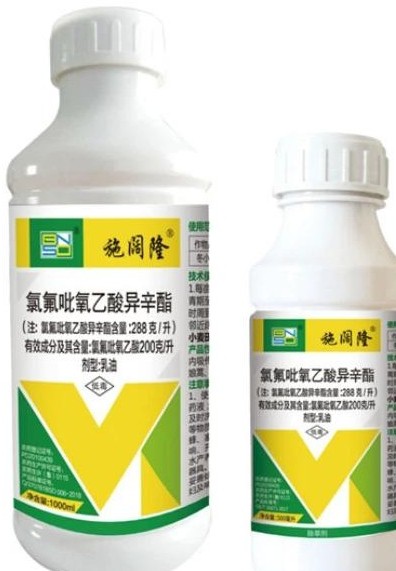
The label rate is 50–70 mL/667 m² (667 m² = 1 mu ≈ 1/15 ha; the rate converts to roughly 750–1050 mL/ha). Export packs are 500 mL × 20 bottles and 1 L × 12 bottles, which cover both smallholder retail and farm-scale supply.
Timing the Application
Auxin-mimic chemistry rewards timing more than most modes of action. The working windows in a winter wheat season are well established in general practice:
- Autumn early post-emergence. When the wheat is at the 3-to-5-leaf stage and the weed flush is at seedling to rosette stage, treatment is cheapest and most complete. Young weeds take up and translocate the active fastest.
- Late-winter to early-spring green-up. Where autumn pressure was missed, the second window opens as overwintered weeds resume growth. Weeds past the rosette stage need the upper end of the rate range and still respond more slowly.
Whatever the window, three conditions make the difference between a clean field and a repeat pass: weeds in active growth (not drought-stopped or frost-stressed), mild temperatures at and after application — auxin activity falls away in cold weather, so avoid applying just before a frost — and several rain-free hours after spraying so leaf deposits are not washed off. Fine, even coverage across the canopy matters more than raw water volume.
Tank-Partner Notes
Fluroxypyr is a working partner in most wheat herbicide programs, and the pairing logic follows from its spectrum:
- Broadleaf partners. Where the local weed spectrum includes species beyond fluroxypyr’s registered targets — for example ALS-inhibitor-based products such as the florasulam + MCPA 40% suspension concentrate (SC) covered in our wheat program article — suppliers and growers commonly pair or sequence broadleaf actives to widen the spectrum. Any combination must follow the destination label and be confirmed with a jar test first.
- Grass-herbicide caution. Tank-mixing auxin herbicides with ACCase-inhibitor grass killers is a documented antagonism risk: the rapid auxin effect on grass-leaf physiology can reduce grass-herbicide uptake. Where the program needs both a broadleaf and a grass treatment, applying them separately, in sequence, is the standard advice.
- No unlabelled partners. Everything mixed into the tank must be permitted by the destination-market label; unregistered combinations are off-label by definition.
Sourcing Fluroxypyr 200 g/L EC: Buyer Checks
Emulsifiable concentrates live or die on formulation quality, and buyers can screen for it without a laboratory:
- Content against COA. Each batch should ship with a HPLC certificate of analysis; the declared 200 g/L is a registered value that must match the goods.
- Emulsion behaviour. A few millilitres dropped into standard hard and soft water should disperse rapidly and hold a stable milky emulsion without creaming, oiling-out or sediment.
- Solvent quality. Cheap ECs sometimes carry impure or off-specification solvents; these show up as odour problems, poor emulsification and pack corrosion. Insist on full specification disclosure.
- Pack and closure integrity. 500 mL and 1 L bottles must survive stacking and temperature swings in transit without leaking; EC is a flammable liquid, and dangerous-goods (Class 3) documentation and packaging should be confirmed before booking — BNSD Agro handles DG cargo compliance as part of export.
- Documents in the supplier’s name. The Chinese registration certificate, production licence and batch traceability should all match the shipment.
The herbicide portfolio, including the other wheat broadleaf actives, is listed in the herbicides catalogue. For samples, registration support documents or OEM packing, contact BNSD Agro.
FAQ
What weeds does fluroxypyr control in winter wheat?
On the Chinese registration label: annual broadleaf weeds, named as cleavers, flixweed, lambsquarters and chickweed, at 50–70 mL/667 m² of the 200 g/L EC. It has no activity on grass weeds, so grass control needs a separate registered product. Always confirm the authorized spectrum on the destination-market label.
When should fluroxypyr be applied to winter wheat?
Two working windows: autumn early post-emergence, when wheat is at the 3-to-5-leaf stage and weeds are young, and late-winter to early-spring green-up as overwintered weeds resume growth. Spray into actively growing weeds under mild temperatures, and avoid application just before frost or rain.
Can fluroxypyr be tank-mixed with grass herbicides?
Caution is the standard answer: auxin herbicides and ACCase-inhibitor grass herbicides can antagonize each other in the tank. Where a program needs both, applying the broadleaf and grass treatments separately in sequence is the safer route. Any specific combination must be sanctioned by the destination label and verified with a jar test.
What export packs are available?
Fluroxypyr 200 g/L EC is packed in 500 mL × 20 bottles and 1 L × 12 bottles for export, sizes that suit both smallholder retail channels and farm-scale supply. Other pack formats for OEM projects can be discussed case by case with the manufacturer.
WhatsApp / WeChat: +86 199 0636 5856