
Mixture products earn their place in a catalogue only when the two components genuinely cover for each other, and florasulam + MCPA is the textbook case in winter wheat. One component is a modern low-dose ALS inhibitor; the other is a classic auxin herbicide with decades of cereal use behind it. BNSD Agro (Shandong Bainong Sida Biotechnology Co., Ltd.) produces the combination as a 40% SC registered for annual broadleaf weeds in winter wheat. This guide explains the two-mode logic, the Chinese label rate, the pack options and the rotation discipline an importer or grower should apply. As always, the rates quoted are Chinese registration label rates; the destination-market label governs in your own market.
Two Modes in One Pack: ALS Inhibition Plus Auxin Activity
The pairing works because the two actives attack plant growth from completely different directions:
- Florasulam — ALS inhibitor. It blocks acetolactate synthase, the enzyme plants need to build the branched-chain amino acids valine, leucine and isoleucine. Treated weeds stop growing almost at once and starve over the following days to weeks. Florasulam is noted for high activity at very low doses on key wheat broadleaf weeds, and for continuing to work in the cool conditions of a winter cereal season.
- MCPA — auxin mimic. A phenoxy-type auxin herbicide used in cereals since the mid-twentieth century. It throws susceptible broadleaf weeds into uncontrolled, distorted growth — twisting, curling, swelling — that ends in collapse. It adds fast, visible knockdown on a broader range of broadleaf species and on weeds that have grown past the seedling stage.
Together the two modes widen the controllable spectrum and make resistance harder to establish: a weed population would need to overcome two unrelated mechanisms at once to survive a properly timed application.
Registered Use and Label Rate
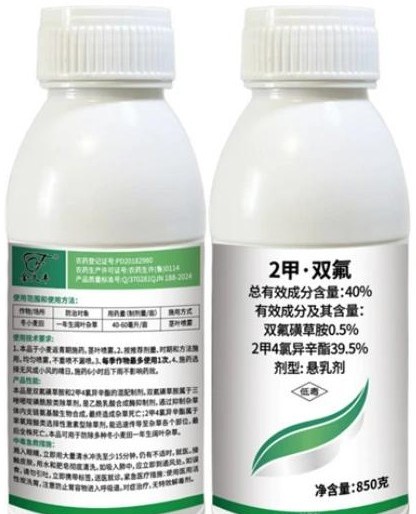
On the Chinese registration label, florasulam + MCPA-isooctyl 40% SC is registered for annual broadleaf weeds in winter wheat at 40–60 mL/667 m² (667 m² = 1 mu ≈ 1/15 ha; converted, roughly 600–900 mL/ha). The suspension-concentrate formulation is dosed by volume on the label and carries these export pack options:
- 850 g × 12 packs — the farm and cooperative format for field-scale treatment;
- 80 g × 800 sachets — the retail carton format for smallholder channels.
Field Timing and Crop Safety
The combination is a post-emergence, over-the-top treatment for the classic winter wheat windows:
- Weed stage first. Best results come when broadleaf weeds are in the 2-to-6-leaf stage and actively growing. Overwintered weeds treated at the spring green-up window respond, but larger plants need the upper end of the rate range and more time to die.
- Two seasonal windows. Autumn early post-emergence and late-winter to early-spring green-up, matching the pattern of weed emergence in a winter cereal. Florasulam’s cool-condition activity makes the combination useful late in the second window, when mornings are still cold.
- Crop stage. Wheat tolerates the product at label rates across the main vegetative stages; the practical rules are to avoid overdosing, avoid treating a crop under stress, and observe the stage limits on the destination label.
- Drift discipline. MCPA is an auxin, and neighbouring broadleaf crops — vegetables, cotton, vines, fruit trees — are sensitive to drift. Buffer zones, low-drift nozzles and wind-speed limits on the label are there for a reason.
Rotation and Resistance Notes
The two-mode design helps resistance management, but it does not replace it:
- Do not make ALS chemistry the whole season’s answer. IRAC-group ALS inhibitors should be limited to one application per crop cycle where possible, in line with standard resistance-management practice.
- Alternate modes between seasons. An auxin-only product such as fluroxypyr 200 g/L emulsifiable concentrate (EC) is a natural rotational partner: alternating an ALS-plus-auxin pass with an auxin-only pass keeps pressure off the ALS target.
- Mind recropping intervals. ALS-inhibitor soil residuals vary with pH, temperature and moisture. Before rotating to sensitive crops after a treated wheat season, follow the recropping intervals on the destination-market label rather than assumptions.
- Scout, then choose. Resistance shows up as patches of surviving weeds. Mapping escapes after each season tells a grower whether the same mode is still earning its place.
Buying the 40% SC: Quality Checklist
Suspension concentrates fail in specific, testable ways, so a buyer can screen quality directly:
- No hard packing. The product should redisperse with gentle shaking after storage, forming a uniform suspension that holds through the spray day.
- Particle fineness and suspension stability. Coarse or flocculating suspensions block nozzles and dose unevenly; a simple dilution-and-stand test in water reveals both.
- Content against COA. The declared 40% (florasulam + MCPA-isooctyl) is a registered value; every batch should ship with an HPLC certificate of analysis.
- Sachet and pack integrity. The 80 g sachets must seal cleanly in humid climates, and the 850 g packs must survive stacking and temperature swings in transit.
- Documents. Chinese registration certificate, production licence and batch traceability, all in the supplier’s own name and matching the goods.
The full herbicide export range is listed in the herbicides catalogue. For samples, registration support documents or OEM packing, contact BNSD Agro.
FAQ
What is florasulam + MCPA 40% SC used for?
On the Chinese registration label: annual broadleaf weeds in winter wheat, at 40–60 mL/667 m². Florasulam contributes a low-dose ALS-inhibitor mode, and MCPA contributes auxin activity, giving two unrelated mechanisms in a single pass. Confirm the authorized weed spectrum on the destination-market label.
What is the rate per hectare?
The Chinese label rate is 40–60 mL/667 m², which converts to roughly 600–900 mL/ha (1 mu = 667 m² ≈ 1/15 ha; multiply the per-mu rate by 15 for the per-hectare rate). The valid rate in your country is the one printed on the destination label.
Why combine an ALS inhibitor with MCPA instead of using either alone?
Spectrum and stewardship. Florasulam works at very low doses on key wheat broadleaf weeds and stays active in cool weather; MCPA adds knockdown on a broader range of species and on larger weeds. Two unrelated modes in one pass also slow the selection of resistant weed populations compared with relying on either mode alone.
What pack options are available for export?
The 40% SC is exported in 850 g × 12 packs for farm and cooperative use and in 80 g × 800 sachet cartons for smallholder retail. Other formats for OEM projects can be discussed with the manufacturer case by case.
WhatsApp / WeChat: +86 199 0636 5856