
Few maize pests punish a fixed spray habit like fall armyworm. The larvae bury themselves inside the whorl where droplets struggle to reach, generations stack on top of each other through the warm months, and a program built around one mode of action loses effectiveness season by season. Fall armyworm control in maize therefore has to be a program: a ladder of insecticides with unrelated modes of action, applied at the right larval stage and placed where the larvae actually feed.
This guide sets out such a program from the BNSD Agro (Shandong Bainong Sida Biotechnology Co., Ltd.) catalogue — a 12% chlorfenapyr + lufenuron SC, emamectin benzoate 5% WDG, a chlorantraniliprole 200 g/L SC and Bt 16000 IU WP — with an IRAC rotation table and the whorl-coverage technique that decides whether any of it works.
A Pest Built to Outrun a Single Product
Fall armyworm (Spodoptera frugiperda) is a global maize pest: native to the Americas, it spread across Africa and Asia within a few seasons and is now established across most maize-growing regions. The adult moth migrates long distances and lays egg masses of dozens to hundreds of eggs on leaves and nearby surfaces. Neonate larvae scrape the leaf surface in groups, producing “window pane” patches; from the third instar onward they tunnel into the whorl, and the ragged, shot-holed leaves that follow are the first visible alarm. Large larvae finish by boring into ears and stalks.
Three consequences follow for any control program:
- The window is early. Small larvae feed exposed on leaf surfaces for only a few days before the whorl shelters them. Sprays timed at egg hatch and first instars cost less and work better.
- The whorl is a fortress. Once inside the funnel of wrapped leaves, larvae sit exactly where conventional flat-fan coverage is weakest.
- Generations overlap. In warm climates the moth cycles continuously, and every repeated generation under the same insecticide mode of action is another selection step toward resistance.
The Program: Four Products, Four Unrelated Modes
The BNSD Agro catalogue holds a lepidoptera ladder that maps directly onto fall armyworm pressure. Each product below carries a Chinese registration label rate; registered crops and uses differ by country, so for fall armyworm on maize always apply according to the destination-market label.
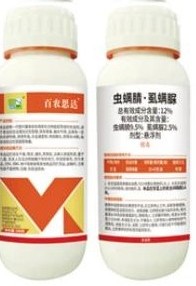
12% Chlorfenapyr + Lufenuron SC: the Spodoptera Anchor
The Chinese label registers this suspension concentrate on beet armyworm at 25–42 g per 667 m² — the same Spodoptera genus that fall armyworm belongs to, and the reason this product anchors the armyworm tier of the program. The two actives are deliberately unrelated: chlorfenapyr (IRAC group 13) uncouples oxidative phosphorylation, collapsing the energy supply of contacted and ingested larvae, while lufenuron (IRAC group 15) is a benzoylurea chitin-synthesis inhibitor that kills larvae at the next molt. Contact activity plus molt-block coverage is exactly the pairing a whorl-dwelling larval population demands.
Emamectin Benzoate 5% WDG: the Stomach-Led Pass
Emamectin benzoate (IRAC group 6) is a stomach-led, trans-laminar insecticide: larvae ingest it while feeding on treated tissue, and it moves into the leaf enough to cover surfaces that received only partial droplets. The Chinese label registers the 5% WDG on cabbage diamondback moth at 3–4 g per 667 m². Its best fit in a fall armyworm program is the early-instar pass, when larvae are feeding near the whorl opening and ingestion is assured.
Chlorantraniliprole 200 g/L SC: Long-Residual Larval Cover
Chlorantraniliprole (IRAC group 28) is a diamide that locks the insect’s muscle regulation open, causing rapid feeding cessation and death within days of ingestion. The Chinese label registers the 200 g/L SC on rice leaffolder at 7–10 mL per 667 m². Diamides are valued in larval programs for their length of residual activity, which lets one well-timed pass cover the hatch from several egg masses — a genuine advantage against a moth that lays continuously.
Bt 16000 IU WP: the Biological Pass
Bacillus thuringiensis (IRAC group 11) works only on ingestion, destroying the midgut of susceptible lepidopteran larvae. The Chinese label registers the 16000 IU WP on rice leaffolder and borers at 100–150 g per 667 m². As a biological, it leaves beneficial insects largely untouched and sits well inside integrated pest management; its practical demands are coverage and timing, since sunlight degrades the toxin and larvae must eat it early.
IRAC Rotation Table
| Product | IRAC group(s) | Chinese label reference use | Label rate | Role in the program |
|---|---|---|---|---|
| 12% chlorfenapyr + lufenuron SC | 13 + 15 | Beet armyworm | 25–42 g/667 m² | Spodoptera anchor: contact kill plus molt block |
| Emamectin benzoate 5% WDG | 6 | Cabbage diamondback moth | 3–4 g/667 m² | Stomach-led pass on young larvae |
| Chlorantraniliprole 200 g/L SC | 28 | Rice leaffolder | 7–10 mL/667 m² | Long-residual cover across egg-hatch waves |
| Bt 16000 IU WP | 11 (microbial) | Rice leaffolder, borers | 100–150 g/667 m² | Biological, IPM-friendly pass |
Standard IRAC practice governs the sequence: never follow one mode of action with another from the same group within a generation, cap applications per group per season, and count a mixture as containing both of its component groups for rotation purposes.
Whorl Coverage: the Technique That Decides the Result
- Spray late in the day. Larvae resume feeding toward evening; applying then puts the deposit in place exactly when ingestion happens — essential for the stomach-active products.
- Drive droplets into the funnel. Direct nozzles into the whorl or use cone-type delivery; a pass that wets only the leaf tops has treated the part of the plant the larvae avoid.
- Commit enough water volume. Whorl penetration is volume-dependent. A lower rate of product in a thorough spray beats the reverse.
- Adjust UAV passes. For drone applications, plan higher water volume and slower flight over whorl-stage maize; a fast, thin pass rarely reaches the funnel.
- Scout for the trigger. Egg masses and fresh window-pane damage are the action signal — treating before the third instar is the single highest-return decision in fall armyworm control.
Kits That Package the Program
For the borer-and-armyworm window, BNSD Agro assembles Sida Golden Autumn maize kits (company information) in two formats: a manual pack sized for one mu (667 m²) and a UAV pack sized for ten mu (about 0.67 ha). Pre-proportioned packs remove the mixing-math errors that come with night-time emergency spraying.

Sourcing and OEM Notes
Bainong Sida holds 70 ICAMA registrations with about 60 pending, releases each batch against the registration standard by HPLC/GC, and packs OEM orders from 10 mL to 40 kg. The insecticide ladder and full range are listed in the insecticides catalogue; for samples, registration documents or kit customization, contact the export team.
FAQ
What is the best insecticide for fall armyworm in maize?
There is no single best product — the working answer is a rotation. The program above pairs 12% chlorfenapyr + lufenuron SC (Chinese label: beet armyworm, 25–42 g/667 m²), emamectin benzoate 5% WDG, chlorantraniliprole 200 g/L SC and Bt 16000 IU WP, each with a different IRAC group. Coverage of the whorl and timing at early instars decide the outcome as much as the product choice. Your destination-market label governs.
How should insecticides be rotated to manage fall armyworm resistance?
Rotate by IRAC group, not by brand: for example a chlorfenapyr + lufenuron (13 + 15) pass, then emamectin benzoate (6), then chlorantraniliprole (28), with Bt (11) as the biological pass. Do not repeat any group within a generation, cap applications per group per season, and treat a two-active mixture as containing both groups.
Can drone spraying reach fall armyworm in the whorl?
Yes, but only with adjusted parameters. Whorl-dwelling larvae are protected from thin, fast passes; plan higher water volume and reduced speed so droplets are driven into the funnel of leaves. The UAV 10-mu format of the Sida Golden Autumn kit is sized for exactly this window.
When should I start spraying for fall armyworm?
At the first sign of egg masses or fresh “window pane” leaf feeding, not when ragged whorls appear. Early instars feed exposed and are far easier to kill than larvae that have already entered the whorl or the ear.
WhatsApp / WeChat: +86 199 0636 5856