
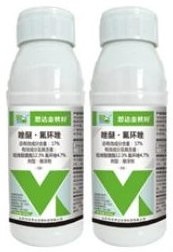
Among the triazoles, epoxiconazole has a specific reputation: it stays active on the leaf longer than most of its chemical siblings. That long residual is the reason buyers keep asking for it, and in the BNSD Agro (Shandong Bainong Sida Biotechnology Co., Ltd.) range it is registered inside a 17% pyraclostrobin + epoxiconazole SC covering soybean leaf spot, wheat powdery mildew and maize northern leaf blight. This guide sets out the molecule’s mode of action, the Chinese label rates, the logic of pairing a QoI with a DMI, and the sourcing checks that decide whether a suspension concentrate is worth shipping. The full range sits on the fungicides page, and samples or registration documents are available through the contact page.
What Is Epoxiconazole?
Epoxiconazole is a triazole fungicide in FRAC group 3, the DMI (demethylase inhibitor) family. It blocks C14-demethylation in fungal ergosterol biosynthesis — a single-site mode of action that disrupts membrane formation in growing fungal tissue. Systemic and xylem-mobile, it combines protectant, curative and eradicant phases of activity like the other DMIs.
Its differentiating property is persistence. Compared with shorter-residual triazoles, epoxiconazole is known for extended residual on the treated canopy: protection stretches over a longer interval between sprays, which lengthens the spray cycle on diseases that reinfect in wet weather. For field crops where one fewer pass per season is worth real money — soybeans, wheat, maize — that property drives the purchase decision more than peak kill speed does.
Under FRAC guidance the DMI family carries a medium resistance risk, so the extended residual comes with the standard obligation: rotation discipline, which the mixture structure below addresses directly.
Registered Uses: 17% Pyraclostrobin + Epoxiconazole SC
In the BNSD Agro range, epoxiconazole is registered in China as part of this combination product:
| Product | Registered target (Chinese label) | Label rate |
|---|---|---|
| 17% pyraclostrobin + epoxiconazole SC | Soybean leaf spot | 50–60 mL/667 m² |
| 17% pyraclostrobin + epoxiconazole SC | Wheat powdery mildew | 40–60 mL/667 m² |
| 17% pyraclostrobin + epoxiconazole SC | Maize northern leaf blight | 40–60 mL/667 m² |
All rates are Chinese registration label rates; 667 m² equals one mu, roughly 1/15 hectare. In your own market the destination label governs — registration scope and rates differ country by country, so treat these figures as a positioning reference, not a spray recipe for another jurisdiction.
The three targets share a pattern: foliar diseases of broadacre crops, all of which press hardest in warm, humid weather, and all of which reward a spray program that can stretch intervals without losing coverage. A long-residual mixture aimed at exactly these crops is a deliberate registration choice.
The QoI + DMI Mixture Logic
Pyraclostrobin is a QoI fungicide (FRAC 11), a respiration inhibitor; epoxiconazole is a DMI (FRAC 3), a sterol-biosynthesis inhibitor. The two modes of action are unrelated, and putting them in one suspension concentrate does three jobs at once:
- Protectant + curative in one pass. The QoI lays down fast, broad protectant activity; the DMI contributes systemic, curative depth for infections already under way. Neither active has to do the other’s job.
- Built-in rotation. Under FRAC principles, limiting the number of consecutive applications of any single-site group is the core of resistance management. A QoI+DMI product delivers two groups in the same spray, cutting selection pressure on either target site while still counting one pass against the spray budget.
- Residual that matches the mixture. The long residual of the epoxiconazole half carries the protection interval; the pyraclostrobin half covers the early infection phases with its own persistence. The mix was built so the interval between sprays is governed by the stronger of the two residuals, not the weaker.
Program Fit: Using Long Residual Without Wasting It
A long-residual triazole rewards planning:
- Front-load the mixture at high-pressure stages. Deploy the product around the growth stages where reinfection cycles run fastest — the flowering-to-pod stages in soybean, the canopy-closure window in wheat, the pre-tassel to grain-fill period in maize.
- Count your group 3 and group 11 applications. Cap the total number per crop cycle as FRAC guidance suggests, and rotate the other passes with multi-site protectants (FRAC M) or other unrelated groups.
- Watch performance, not just weather. If efficacy on powdery mildew targets drifts, adjust the program rather than raising the dose — sensitivity shifts in DMI groups most often show on mildews first.
Sourcing a Pyraclostrobin + Epoxiconazole SC: Buyer Checklist
A suspension concentrate is a solid active dispersed in a liquid phase, so its quality is physical as much as chemical:
- No crystallisation. The active must stay evenly dispersed through the hot and cold cycles of the shipping route; recrystallised particles grow, scorch leaves and block nozzles.
- Suspensibility after dilution. The diluted spray should stay uniform for the whole job with only gentle agitation — no hard sediment, no layering.
- Content released by HPLC against the registration standard. Content is a registered value, not a marketing range. At BNSD Agro every batch is analysed by HPLC or GC and released against the registration standard before shipment (company practice).
- Viscosity and pouring behaviour. An over-thick SC pours badly, foams in the tank and short-weights on the filling line.
- Documents and pack ladder. Pesticide registration certificate, production licence and batch traceability in the supplier’s own name, with retail sachets through bulk packs agreed in the contract.
FAQ
What is epoxiconazole registered for in China?
In the BNSD Agro range, epoxiconazole appears in the 17% pyraclostrobin + epoxiconazole SC, registered for soybean leaf spot at 50–60 mL/667 m², wheat powdery mildew at 40–60 mL/667 m² and maize northern leaf blight at 40–60 mL/667 m². Destination-label terms govern in your market.
Why is epoxiconazole considered a long-residual triazole?
Compared with shorter-residual triazoles, epoxiconazole is known for extended protection on the treated canopy, which lengthens the interval between sprays. That is a general property of the molecule’s behaviour on leaf surfaces, not a laboratory figure — plan your own spray intervals against local pressure and the destination label.
What does the pyraclostrobin partner add?
Pyraclostrobin is a QoI (FRAC 11) respiration inhibitor with strong protectant activity. Paired with the DMI, it delivers protectant plus curative in one pass and puts two unrelated mode-of-action groups into the same spray — the rotation built into the product.
What should buyers check when sourcing this SC?
No crystallisation through temperature cycling, suspensibility after dilution, HPLC content release against the registration standard, sensible viscosity, and complete documents with an agreed pack ladder — the checklist above.
WhatsApp / WeChat: +86 199 0636 5856