
Emamectin benzoate sits in every serious buyer’s shortlist for caterpillar control: potent at gram-scale rates, compatible with rotation programs and available from Chinese manufacturers in several formulation and combination forms. This guide covers what the active actually is, why the salt form matters, how the 5% WDG and 1% EC are registered and used in China, and what to verify before ordering.
What Is Emamectin Benzoate?
Emamectin benzoate is a semi-synthetic derivative of avermectin, a class of macrolide compounds originally derived from soil microorganisms. In the IRAC classification it belongs to group 6 — glutamate-gated chloride channel allosteric modulators. Binding these channels in insect nerve and muscle cells disrupts signalling, and the practical result is rapid feeding cessation followed by death, typically within one to three days.
Three working properties matter to field programs:
- Stomach-led action. The active performs primarily through ingestion. Larvae stop feeding almost immediately after contact with treated foliage, which limits further crop damage even before they die.
- Trans-laminar movement. The active penetrates leaf tissue and forms a reservoir within the leaf, giving residual control of larvae that feed on the underside. It is not truly systemic, so coverage of the leaf surface still matters.
- Lepidoptera potency. Against caterpillars — diamondback moth, beet armyworm, cabbage worm and related species — it works at gram-scale rates per mu, far below most contact insecticides.
Mammalian toxicity is comparatively low, but group 6 actives are hazardous to fish and aquatic invertebrates and to bees when wet — standard precautions of the destination label apply.
The Benzoate Salt: Why the Form Matters
Avermectin chemistry comes with a formulation constraint: the free base is poorly soluble in water. Converting it to the benzoate salt — which is what “emamectin benzoate” on a label means — improves water solubility and formulation stability compared with the free base. In practice this is what makes a water-based granule or a stable emulsion possible at all, and why the name on the specification sheet should always be checked, not just the family name “emamectin.”
Emamectin Benzoate 5% WDG: The Flagship
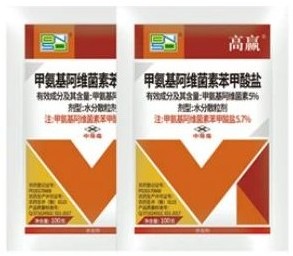
On its Chinese registration, BNSD Agro’s (Shandong Bainong Sida Biotechnology Co., Ltd.) 5% WDG is registered for cabbage diamondback moth at 3–4 g per 667 m² (one mu, 1/15 ha) as a foliar spray. Pack sizes run from 10 g × 800 sachets through 100 g × 100 bags, matching smallholder sachet retail up to larger farm-scale bags.
Why WDG dispersibility matters so much here
A 3–4 g dose per mu is among the smallest rates in crop protection. The active has to be distributed evenly across the sprayed area — a granule that disperses slowly or leaves undispersed agglomerates in the tank delivers an uneven dose across the field: some rows under-dosed, resistance pressure building, others over-dosed and wasted. For this reason, when sourcing an emamectin 5% WDG, dispersion behaviour is the single most telling physical test:
- the granule should wet and break apart quickly in water with only light agitation;
- the suspension should remain uniform for the duration of a spray operation;
- granules should be free-flowing and dust-free, with no caking in the pack.
Emamectin Benzoate 1% EC
The second formulation, an emulsifiable concentrate, is registered for beet armyworm on brassicas at 10–20 mL per 667 m². Where the WDG suits dry, dust-conscious supply chains, the EC blends readily into liquid tank mixes and is a familiar format for spray-service operations. The standard EC quality checks apply: emulsion stability after dilution, and no separation or crystallization after hot and cold storage.
All rates in this article are Chinese registration label rates; follow the destination-market label in your own territory.
BNSD Agro Combination Products
According to company information, BNSD Agro pairs emamectin benzoate with three partners, each pairing two IRAC groups in one application — useful where rotation windows are tight:
| Combination | Registered use (Chinese label) | Rate |
|---|---|---|
| 11.6% emamectin benzoate + chlorantraniliprole suspension concentrate (SC) | Cabbage diamondback moth | 5–10 mL/667 m² |
| 9.8% emamectin benzoate + lufenuron SC | Cabbage diamondback moth | 10–15 mL/667 m² |
| 3.2% emamectin benzoate + beta-cypermethrin micro-emulsion (ME) | Beet armyworm | 40–60 mL/667 m² |
The logic is consistent: emamectin (IRAC 6) contributes fast feeding-stop and trans-laminar residual; the partner contributes a different mode of action and complementary activity — chlorantraniliprole (IRAC 28) for long lepidopteran residual, lufenuron (IRAC 15) for larval development disruption, beta-cypermethrin (IRAC 3A) for knockdown.
Sourcing Checklist
Before ordering emamectin benzoate, whether WDG or EC:
- Content on the COA. HPLC-verified active content matching the registration certificate, batch after batch. Content is a registered value — treat “or higher” claims as a flag, not a bonus.
- For the 5% WDG: dispersion and suspensibility, dust-free granule, no caking under compression or humidity.
- For the 1% EC: emulsion stability after dilution, clarity, no crystals after hot/cold storage.
- Salt form named. The specification should state emamectin benzoate explicitly, with content expressed accordingly.
- Documents and traceability. ICAMA registration certificate, production licence and batch coding in the manufacturer’s own name; retain samples from each shipment.
BNSD Agro’s full insecticide and acaricide range — 43 export SKUs including the formulations and combinations above — is listed in the insecticides and acaricides catalogue. For samples, registration documents or a quote, contact BNSD Agro.
FAQ
What is the difference between emamectin benzoate and abamectin?
Both are avermectin-family actives in IRAC group 6, but abamectin is the natural fermentation product used against mites and some insects, while emamectin benzoate is the semi-synthetic derivative optimized for Lepidoptera — more potent per gram against caterpillars, which is why its rates run in single grams per mu.
What is the label rate for diamondback moth?
On BNSD Agro’s Chinese registration, emamectin benzoate 5% WDG is applied at 3–4 g per 667 m² for cabbage diamondback moth. The 1% EC is registered for beet armyworm on brassicas at 10–20 mL per 667 m². Follow the destination-market label.
Why is emamectin benzoate sold as a WDG?
The benzoate salt improves water solubility and stability versus the free base, which allows a water-dispersible granule to be made at all. WDG at 5% offers high content, dust-free handling and good storage behaviour — provided dispersion quality is there.
Does emamectin benzoate work by contact or stomach?
Primarily by ingestion: larvae cease feeding almost immediately after ingesting treated foliage. It is also trans-laminar, moving into leaf tissue to control larvae feeding on the underside, but it is not systemic — spray coverage still matters.
WhatsApp / WeChat: +86 199 0636 5856