
Difenoconazole is the triazole buyers reach for when a program needs long residual cover and a wide fungal spectrum from a single active — and in Chinese registrations it appears in two very different formats: a 10% WDG for specialty-crop foliar programs and a 300 g/L combination EC for cereal sheath blight. This guide walks through both products held by BNSD Agro (Shandong Bainong Sida Biotechnology Co., Ltd.), their registered uses and Chinese label rates, the formulation checks behind each, and the rotation logic that keeps a group 3 chemistry earning its place. The full range is on the fungicides catalogue, and samples or documents are available through the contact page.
What Is Difenoconazole?
Difenoconazole is a triazole fungicide in FRAC group 3, the DMI (demethylase inhibitor) family. It blocks C14-demethylation in fungal sterol biosynthesis — a single-site mode of action — and pairs it with properties that suit long-interval programs:
- Systemic and strongly translocated. The molecule moves in the plant’s water stream into new growth, so a spray keeps protecting tissue that develops after application.
- Long residual activity. Difenoconazole is known among the triazoles for extended persistence on the leaf surface and within the canopy, which is why it anchors programs on crops with rapid foliage growth.
- Protectant plus curative performance. As with other DMIs, it acts both ahead of infection and against young, established lesions.
As with every group 3 chemistry, resistance discipline applies: cap the applications, rotate the modes of action, and let mixtures do part of the work. Difenoconazole’s breadth has made it one of the most widely registered triazoles worldwide, and the two BNSD Agro registrations below show how different the delivery formats can be for the same molecule.
The 10% WDG: Registered Uses and Rates
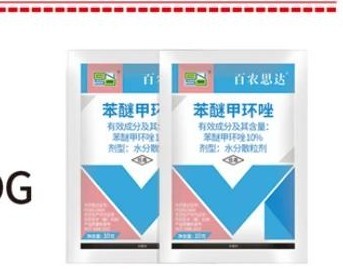
| Product | Registered target (Chinese label) | Label rate |
|---|---|---|
| Difenoconazole 10% WDG | Watermelon anthracnose | 40–60 g/667 m² |
| Difenoconazole 10% WDG | Sesame stem rot | 50–70 g/667 m² |
All rates are Chinese registration label rates (667 m² = one mu, about 1/15 hectare); follow destination-label guidance in your own market.
The formulation is the selling point as much as the uses. The 10% WDG is manufactured as a dust-free granule that disperses instantly in the tank — no powder cloud when opening the pack, no dispersion residue in filters, no hard lumps after storage. For specialty crops such as watermelon and sesame, typically served through smallholder and village-retail channels, sachet-friendly granules that pour clean and dissolve fast are what actually move at the counter.
The two registered targets are also worth a buyer’s attention. Watermelon anthracnose is a leaf-and-fruit disease that builds in warm, wet weather and punishes any program without a durable systemic in it. Sesame stem rot attacks the crop at its base and stem, where systemic movement from a foliar spray matters more than deposit alone. Both are niches where a long-residual triazole has clear positioning against short-lived protectants.
The 300 g/L Combination EC: Difenoconazole + Propiconazole
The second format doubles the triazole logic: 300 g/L difenoconazole + propiconazole EC combines two DMI actives with complementary behaviour — difenoconazole for its long residual and translocation, propiconazole for its own spectrum strength. Registered Chinese label uses:
- Wheat sheath blight — 20–30 mL/667 m²;
- Rice sheath blight — 20–25 mL/667 m².
Sheath blight in both crops is a basal-stem disease driven by dense canopy and humid conditions, exactly where a twin-triazole liquid formulation applied at the canopy base earns its registration. Note the rate expression again: low per-area rates in millilitres, easy to convert into per-hectare program planning and into the dose-per-mu conventions of Chinese field service. Destination-label guidance governs everywhere else.
The EC formulation also carries practical meaning for buyers: an emulsifiable concentrate must form a stable, milk-white emulsion in the tank and hold it without creaming or oiling out. That emulsion stability is a batch-quality property, which brings us to sourcing.
Sourcing Checks: WDG Dispersibility and EC Emulsion
Two different physical tests decide product quality here:
For the 10% WDG:
- Instant, complete dispersion on contact with tank water — no floating crust, no lumps.
- Dust-free granule — fines cause handling loss and operator exposure, and they signal poor granulation.
- No caking after compression and through the hot/cold cycles of sea freight.
- Content by HPLC against the registration standard — at BNSD Agro every batch is released by HPLC or GC analysis before shipment (company practice).
For the 300 g/L EC:
- Emulsion stability after dilution — uniform, no creaming, no oil separation.
- Content of both actives by GC or HPLC against the registered specification, since a combination product must hit two declared values, not one.
- Cold stability, because EC formulations are the ones most likely to throw crystals or phase-separate in winter shipments.
Documentation closes the loop for both: pesticide registration certificate, production licence and batch traceability in the supplier’s own name, with pack sizes agreed in the contract.
Rotation and Resistance Notes
Difenoconazole sits in FRAC group 3, so the standing guidance applies: limit the number of DMI applications per crop cycle, do not follow group 3 with group 3 where programs allow a choice, and rotate with unrelated groups. The two products in this guide make rotation straightforward in practice — the WDG serves specialty-crop windows where it alternates with multi-site protectants or QoI mixtures, while the difenoconazole + propiconazole EC is itself a registered mixture carrying two DMI profiles in one pass, positioned at specific windows rather than repeated through the season. Monitor field performance year on year and adjust the program — not the dose — if efficacy drifts.
FAQ
What is difenoconazole 10% WDG registered for?
On the BNSD Agro Chinese registration: watermelon anthracnose at 40–60 g/667 m² and sesame stem rot at 50–70 g/667 m². Uses in your own market are defined by the destination label.
What does the 300 g/L difenoconazole + propiconazole EC cover?
Sheath blight in cereals: wheat at 20–30 mL/667 m² and rice at 20–25 mL/667 m² on the Chinese label — a twin-DMI emulsifiable concentrate built for basal-stem disease programs.
Why choose a WDG over a wettable powder (WP) or suspension concentrate (SC) for difenoconazole?
A WDG carries no solvent, stores through freezing, pours dust-free and disperses instantly — the clean-handling format for smallholder retail. The 10% WDG here is specifically a dust-free, instantly dispersing granule.
How should difenoconazole be rotated?
As a group 3 DMI: cap DMI applications per cycle, alternate with other FRAC groups, and use registered mixtures such as the difenoconazole + propiconazole EC at defined windows. Change the program, not the dose, if performance slips.
WhatsApp / WeChat: +86 199 0636 5856