
Soil insect control is a different trade from foliar spraying. The pest lives where the spray droplet rarely reaches, the crop is often too dense for good coverage, and the window between “too early” and “too late” is short. That is why root drench products hold a special place in allium production, and why clothianidin 48% SC attracts a dedicated buyer profile. This guide explains the molecule, the chive maggot registration on file at BNSD Agro (Shandong Bainong Sida Biotechnology Co., Ltd.), the technique points that make or break a drench program, and the two-way combo that extends the same logic to garlic.
Clothianidin Basics: IRAC Group 4A
Clothianidin is a second-generation neonicotinoid classified in IRAC group 4A, acting on nicotinic acetylcholine receptors in the insect nervous system. Two properties make it a natural soil-insecticide candidate:
- Systemic movement from the root zone. Applied to soil or the root zone, the active is taken up by the roots and translocated upward through the plant — which means the protection is delivered from inside, to tissue a contact spray cannot economically cover.
- Contact and stomach action. Larvae in the treated soil zone are affected directly, and adults feeding on treated foliage or exudates pick up the active as well.
Mammalian toxicity is comparatively low, as is typical of the group, but clothianidin — like all 4A actives — is highly toxic to bees and aquatic organisms, so buffer and drift rules still apply even in drench work.
The Registered Use: Chive Maggot Drench at 40–50 mL per Mu
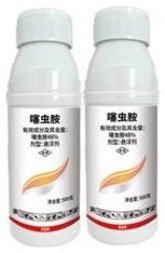
The Chinese registration held by BNSD Agro covers chive maggot as a root drench at 40–50 mL/667 m² of the 48% SC. Chive maggot — the larval stage of flies that lays eggs at the base of chive clumps — is the classic root-zone pest of allium production: larvae feed on bulbs and roots, plants yellow in patches, and by the time symptoms show, the population is already established under the soil surface. This is exactly the situation where a foliar spray fails and a drench earns its keep: the active is carried down into the root zone, where the larvae actually live.
Timing matters as much as the product. Drench programs are generally positioned against the egg and early-larval stages — before larvae tunnel into the bulb — which is why field scouting for adult fly activity and egg-laying periods drives the schedule rather than visible plant damage.
Pack sizes run at 500 g × 20 bottles, sized for cooperative and farm-store distribution.
Drench Technique Notes
A drench only works if the active actually reaches the larvae. The technique points below are standard practice for root-zone soil treatments and apply equally to this 48% SC:
- Direct the liquid to the root zone, not the foliage. The goal is percolation into the top few centimetres of soil around the plant base. Foliar deposits are wasted product in a maggot program.
- Use enough water volume. A drench needs volume to move: too little water leaves the active sitting on the surface. Follow the destination-label instructions on water rate per mu, and apply evenly along the rows.
- Mind the soil moisture. Very dry soil sheds water down cracks; saturated soil cannot absorb the suspension. Moderately moist ground at application, followed by light irrigation or a rainfall event, moves the active into the zone where larvae feed.
- Water in after application where the label directs it. A light irrigation after drenching washes surface residue into the root zone and reduces photodegradation of surface deposits.
- Calibrate the applicator. Whether by knapsack lance or powered equipment, output per metre of row should be checked — uneven delivery produces the patchy control that gets blamed on the product.
All rates are Chinese registration label rates (667 m² = one mu ≈ 1/15 ha). In your own market, always follow the destination-market label for rates, water volumes and pre-harvest intervals.
The 26% Lambda + Clothianidin SC: the Garlic Extension
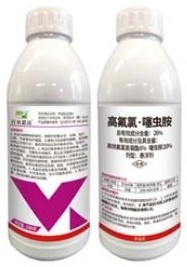
BNSD Agro’s clothianidin range also includes a two-way combination — 26% lambda-cyhalothrin + clothianidin SC — registered for garlic root maggot as a drench at 2000–4000× dilution. The pairing repeats the logic that runs through combination products: clothianidin (4A) provides the systemic, residual root-zone activity; lambda-cyhalothrin (3A) adds fast contact and stomach action against the adult flies and newly hatched larvae. Garlic root maggot is the same class of problem as chive maggot — eggs laid at the plant base, larvae attacking the underground organ — so the delivery method carries over: dilute, drench the root zone, water in.
The dilution-based rate also illustrates how label conventions differ between products: the 48% SC is dosed per mu in millilitres, while the 26% combo is dosed as a dilution factor. Neither convention substitutes for the other — each product is used exactly as its own label directs.
Rotation and Stewardship
Clothianidin sits in IRAC group 4A, so the same rules that govern every neonicotinoid apply to drench programs:
- Do not follow a group 4A drench with another group 4A product against the same pest generation, and cap the number of 4A applications per crop cycle.
- Rotate with unrelated modes of action — group 1, group 3A, group 6 or group 28 products, as registered locally for soil use — and integrate non-chemical measures such as crop rotation away from continuous allium cropping, which reduces pest carry-over between seasons.
- Note that a drench is not exempt from pollinator discipline: systemic uptake means residues can reach pollen and nectar, so applications must respect the bee-protection and flowering-crop provisions of the destination-market label.
Both the 48% SC and the 26% combo are listed in the insecticides and acaricides catalogue of BNSD Agro. For samples, registration documents or OEM packing, contact BNSD Agro.
FAQ
What is the label rate for clothianidin 48% SC against chive maggot?
The Chinese registration specifies a root drench at 40–50 mL/667 m². Rates, water volumes and timing are label properties — always transfer them from the destination-market label in your own country.
How does a drench differ from a foliar spray?
A drench deliberately puts the active into the soil root zone, where it is taken up systemically by the roots and where soil-dwelling larvae such as root maggots live. A foliar spray targets the canopy; against larvae feeding underground it is largely wasted. Drench work therefore depends on water volume, soil moisture and even delivery rather than on nozzle pressure alone.
What is the difference between clothianidin 48% SC and the 26% combo?
Content, partner active and target: the 48% SC is a single-active product registered for chive maggot drench at 40–50 mL/667 m², while the 26% lambda-cyhalothrin + clothianidin SC is a two-way combination registered for garlic root maggot at 2000–4000× dilution. Each follows its own label — the rate conventions are not interchangeable.
How should clothianidin programs be rotated?
Treat it as a group 4A tool: no 4A followed by 4A on the same pest generation, a capped number of 4A applications per crop cycle, and rotation with unrelated IRAC groups plus non-chemical measures such as rotating allium ground. Even in drench use, follow the bee-protection and flowering-crop provisions of the destination-market label.
WhatsApp / WeChat: +86 199 0636 5856