
When a vegetable program starts failing against caterpillars that used to die to the standard shelf, buyers start asking about chlorfenapyr — and with good reason. Its mode of action sits outside the families that carry most resistance histories, and as a pro-insecticide it is switched on by the pest’s own metabolism. In the BNSD Agro (Shandong Bainong Sida Biotechnology Co., Ltd.) range, chlorfenapyr is registered inside two combination suspension concentrates, paired with lufenuron and with emamectin. This guide covers the chemistry that makes it a resistance-management tool, the Chinese label rates for beet armyworm and diamondback moth, the safety framing the molecule demands, and the sourcing checks for the SC. The insecticide range sits on the insecticides page, and samples or registration documents are available through the contact page.
What Is Chlorfenapyr?
Chlorfenapyr is a pyrrole insecticide in IRAC group 13. Two facts about its chemistry explain why it behaves so differently from the usual caterpillar products:
- It is a pro-insecticide. The formulated material is inactive as such; mixed-function oxidases (MFOs) inside the insect remove a protecting group and release the active metabolite. The pest effectively activates its own poison, which is why activation-driven products behave differently in resistant insects than a directly active compound would.
- It uncouples oxidative phosphorylation. The released active disrupts the proton gradient in the insect’s gut cells, collapsing the energy supply — a mode of action shared by very few commercial groups (IRAC 13), and unrelated to the sodium channels of pyrethroids, the receptors of neonicotinoids, the ryanodine receptors of diamides or the glutamate-gated channels of the avermectins.
The field-facing consequence: chlorfenapyr delivers contact and stomach activity with genuine speed, and it has a documented history of effectiveness on populations already resistant to organophosphates and pyrethroids — the standard situation in intensive vegetable belts where those older chemistries have been sprayed for decades.
Registered Uses: Two Combo SCs
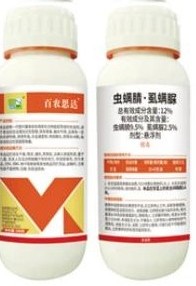
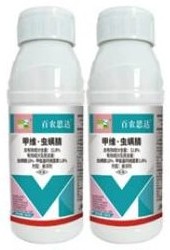
In the BNSD Agro range, chlorfenapyr is registered in China inside two combination products:
| Product | Registered target (Chinese label) | Label rate |
|---|---|---|
| 12% chlorfenapyr + lufenuron SC | Beet armyworm | 25–42 g/667 m² |
| 11.8% emamectin + chlorfenapyr SC | Diamondback moth | 20–40 mL/667 m² |
All rates are Chinese registration label rates; 667 m² equals one mu, roughly 1/15 hectare. In your own market the destination label governs — registration scope and rates differ country by country, so treat these figures as a positioning reference, not a spray recipe for another jurisdiction.
The Pro-Insecticide Advantage: Breaking Resistant Populations
Chlorfenapyr earns its place in programs on three counts:
- A rare mode of action. IRAC 13 uncouplers have no overlap with the organophosphates, pyrethroids, carbamates or avermectins that dominate resistance records in vegetable pests. Introducing chlorfenapyr into a tired program is introducing a genuinely new group.
- Activation works with the resistance story, not against it. Because the insect’s own MFOs activate the molecule, the compound rides on metabolic machinery the larva cannot simply switch off — one reason it stays effective on populations where direct-acting contact insecticides have drifted.
- Speed where it counts. Against beet armyworm and diamondback moth, larvae stop damaging within a short window after intake. That speed is the reason the two registered products pair chlorfenapyr with a persistence active rather than relying on it alone.
The 12% chlorfenapyr + lufenuron SC (beet armyworm, 25–42 g/667 m²) is built for outbreak pests: chlorfenapyr provides the fast visible phase, lufenuron the residual and ovicidal phase. The 11.8% emamectin + chlorfenapyr SC (diamondback moth, 20–40 mL/667 m²) combines emamectin’s rapid feeding cessation with the same fast knockdown chemistry — two distinct modes of action in one pass against a pest famous for burning through single actives.
Safety Framing: Handle the Profile Honestly
Chlorfenapyr is a serious tool and its safety profile must be presented without trimming — this is what buyers should say to their own distributors and growers:
- Toxic to fish and birds. The active is hazardous to aquatic organisms and to birds; keep applications away from water bodies, ponds and aquaculture installations, and manage drift accordingly. Buffer discipline around water is part of the label, not an optional extra.
- Operator protection applies. Standard label PPE, mixing discipline and re-entry intervals govern use; the low-solvent SC form helps, but handling rules still come from the destination label.
- Use inside the label. Rates, crop list and pre-harvest intervals live on the destination label. A resistance-management tool loses its value the moment it is misused into its own resistance problem — cap consecutive IRAC 13 applications and rotate with unrelated groups (IRAC 6, 15, 22A, 28).
None of this framing weakens the product’s commercial case; buyers who present the safety profile accurately are the ones whose registrations and channels survive.
Sourcing a Chlorfenapyr SC: Buyer Checklist
A suspension concentrate is a solid active dispersed in a liquid phase, so quality is physical as much as chemical:
- No crystallisation. The active must stay evenly dispersed through hot and cold shipping cycles; recrystallised particles scorch leaves and block nozzles.
- Suspensibility after dilution. Uniform through the whole spray job with gentle agitation — no hard sediment, no layering.
- Content released by HPLC against the registration standard. Two actives means two assays. At BNSD Agro every batch is analysed by HPLC or GC and released against the registration standard before shipment (company practice).
- Viscosity and pouring behaviour. Over-thick SCs pour badly, foam in the tank and short-weight on the filling line.
- Documents and pack ladder. Pesticide registration certificate, production licence and batch traceability in the supplier’s own name, with pack sizes agreed in the contract.
FAQ
What is chlorfenapyr registered for in China?
In the BNSD Agro range, chlorfenapyr appears in two combos: 12% chlorfenapyr + lufenuron SC for beet armyworm at 25–42 g/667 m², and 11.8% emamectin + chlorfenapyr SC for diamondback moth at 20–40 mL/667 m². Destination-label terms govern in your market.
Why is chlorfenapyr called a pro-insecticide?
The formulated molecule is inactive until mixed-function oxidases inside the insect remove a protecting group and release the active metabolite, which then uncouples oxidative phosphorylation. The pest’s own metabolism switches the compound on.
Is chlorfenapyr effective against resistant caterpillars?
It has a documented history of effectiveness on populations resistant to organophosphates and pyrethroids, because its IRAC 13 mode of action is unrelated to those families. Rotation discipline still applies — no mode of action should be run consecutively.
What safety points matter when positioning chlorfenapyr?
It is toxic to fish and birds: keep sprays away from water bodies and aquaculture, manage drift, and enforce label PPE and re-entry rules. Rates, crops and pre-harvest intervals follow the destination label.
WhatsApp / WeChat: +86 199 0636 5856