
Chlorantraniliprole changed the economics of caterpillar control when it reached the market: low use rates, long residual and a safety profile that made it usable in intensive cropping. Demand from importers keeps growing, but so does confusion — especially around combination products and the pesticide-fertilizer granule line that carries this active. This guide sets out what chlorantraniliprole is, how the 200 g/L SC is registered and used in China, what the mediated-fertilizer granules actually contain, and what to check before sourcing.
What Is Chlorantraniliprole?
Chlorantraniliprole is a diamide insecticide in IRAC group 28. It acts as a ryanodine receptor modulator: it binds the receptor that regulates muscle contraction in insects, causing uncontrolled calcium release, feeding cessation, paralysis and death. Two characteristics define its market position:
- Lepidoptera specialist. Caterpillars — rice leaffolder, stem borers, diamondback moth, armyworms and other lepidopteran larvae — are the core target. This selectivity is a genuine strength: it leaves beneficial insects largely untouched and fits well into IPM programs.
- Low mammalian toxicity. Insect ryanodine receptors differ enough from mammalian ones that the active is regarded as among the safer insecticides for operators and consumers — a well-established property of the diamide class.
The chemistry works by ingestion and shows strong translaminar movement in leaf tissue, with residual control measured in weeks rather than days under normal conditions.
Chlorantraniliprole 200 g/L SC: Registered Use and Rates
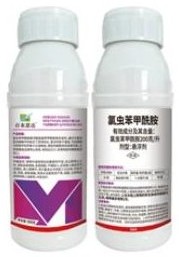
On its Chinese registration, BNSD Agro’s (Shandong Bainong Sida Biotechnology Co., Ltd.) 200 g/L SC is registered for rice leaffolder at 7–10 mL per 667 m² (one mu, 1/15 ha) as a foliar spray — rates typical of the class, where single-digit millilitres per mu do the work that older chemistries did at ten times the volume.
Packs run from small sachets to bottles: 20 g × 300 sachets up to 1 kg × 12 bottles, a ladder that serves smallholder retail through to farm-supply channels.
As with every product discussed here, the rate quoted is the Chinese registration label rate. In your market, follow the destination-market label — the registered crops, targets and rates of the same product differ between countries.
The Mediated-Fertilizer Line: 0.16% Chlorantraniliprole + Clothianidin GR
The most distinctive chlorantraniliprole product in the Chinese market is not a spray at all. The 0.16% chlorantraniliprole + clothianidin GR (0.04% + 0.12%) is a mediated fertilizer — pesticide and nutrition in a single granule, applied as base fertilizer in one pass before or at planting.
The line (company information) is built around three crop-specific NPK grades, each in 40 kg bags:
| Crop program | NPK grade | Base | Pack |
|---|---|---|---|
| Maize | 28-8-6 | standard | 40 kg bag |
| Peanut | 12-18-15 | sulphate of potash | 40 kg bag |
| Potato / sweet potato / ginger | 15-9-21 | sulphate of potash | 40 kg bag |
The logic pairs two active ingredients with complementary profiles: clothianidin (IRAC 4A, neonicotinoid) takes soil and early-season sucking pests, while chlorantraniliprole (IRAC 28) covers lepidopteran larvae through the establishment phase. The crop’s base fertilization and its insect protection are delivered in the same broadcast operation. BNSD Agro markets this line under the Sida Guard series; the full granule range is on the insecticide-fertilizer granules page.
Combination Products — and Look-Alikes to Check Carefully
One genuine combination product sits alongside the single active:
- 11.6% emamectin benzoate + chlorantraniliprole SC — registered for cabbage diamondback moth at 5–10 mL/667 m². Emamectin (IRAC 6) adds fast stomach poisoning to the diamide’s residual control, a common pairing for high-pressure diamondback moth markets.
Here buyers need care with names. The BNSD catalogue also contains combination products that look similar but contain no chlorantraniliprole at all: the 11.8% emamectin + chlorfenapyr SC, the 9% emamectin + indoxacarb SC and the 12% chlorfenapyr + lufenuron SC. These are legitimate products for their own registered targets, but they are not diamides. When comparing quotations, check the active-ingredient declaration on the specification sheet rather than the product family name — a mix-up at the enquiry stage becomes a registration problem at the import stage.
Sourcing Chlorantraniliprole 200 g/L SC: What to Check
- Suspension stability. An SC is a solid suspended in liquid. Check that the product does not separate into a hard sediment on standing, redisperses completely with gentle shaking, and shows no crystal growth after hot/cold storage cycles.
- Content uniformity. Batch COA from HPLC should show the declared 200 g/L against the registration certificate, consistently across batches — uniformity batch to batch matters as much as any single value.
- Physical condition on receipt. No layering, no hard bottom cake, viscosity stable.
- Pack range. 20 g sachets for smallholder retail through 1 kg bottles for field-scale use; confirm the ladder and packaging material in the contract.
- Documents. ICAMA registration certificate, production licence and batch traceability, all in the manufacturer’s own name.
The single active and the 11.6% combination are listed in the insecticides and acaricides catalogue. For samples, registration documents or a quotation, contact BNSD Agro.
Resistance: Why Rotation Matters with IRAC 28
Diamides have been used intensively against Lepidoptera worldwide, and resistance in some diamondback moth and other caterpillar populations is a documented consequence of overuse. The practical rules:
- Do not follow a group 28 spray with another group 28 spray in the same or next generation.
- Cap the number of diamide applications per crop cycle.
- Rotate with unrelated modes of action — IRAC 6 (emamectin benzoate), IRAC 15 (lufenuron), IRAC 3A or IRAC 1, as available and registered locally.
Combination products such as the 11.6% emamectin + chlorantraniliprole SC bring two unrelated groups into one application, which is one reason they remain effective in high-pressure markets.
FAQ
What pests does chlorantraniliprole control?
Primarily Lepidopteran larvae: rice leaffolder and stem borers in rice, diamondback moth and cabbage worms in brassicas, armyworms and borers in maize and vegetables. In the mediated-fertilizer granule it is paired with clothianidin for soil and early-season protection. Always follow the destination-market label.
What is the label rate for rice leaffolder?
On BNSD Agro’s Chinese registration, chlorantraniliprole 200 g/L SC is applied at 7–10 mL per 667 m² (one mu) as a foliar spray. Rates in other markets follow the local label.
What is the 0.16% chlorantraniliprole + clothianidin GR?
A mediated fertilizer — pesticide and fertilizer in one 40 kg granule, applied as base fertilization. It combines chlorantraniliprole and clothianidin with crop-specific NPK grades: 28-8-6 for maize, 12-18-15 (sulphate) for peanut, and 15-9-21 (sulphate) for potato, sweet potato and ginger.
How do I verify a chlorantraniliprole supplier?
Ask for the ICAMA registration certificate and production licence in the supplier’s own name, match the COA content to the certificate, and check the physical quality of the SC — suspension stability and redispersion. Confirm the exact active-ingredient list for any combination product before ordering.
WhatsApp / WeChat: +86 199 0636 5856