
Bifenthrin remains one of the most enquired-after pyrethroids on a Chinese manufacturer’s export list: economical per hectare, broad against chewing pests, and available in more formulation types than most actives. The questions buyers actually ask are narrower — why an EW, what the granule is for, and which combinations are genuine registrations. This guide answers all three from the standpoint of BNSD Agro (Shandong Bainong Sida Biotechnology Co., Ltd.), using the registered products and Chinese label rates on file.
What Is Bifenthrin?
Bifenthrin is a pyrethroid insecticide classified in IRAC group 3A. Like all 3A actives it works as a voltage-gated sodium channel modulator, keeping insect nerve cells firing until the pest is paralysed. Four properties define how it is used:
- Contact and stomach action, no systemic movement. The active kills on touch and through feeding, but does not move inside the plant — coverage is everything.
- Strong knockdown. Treated pests stop feeding and drop quickly, which is why pyrethroids remain the visible “results” product in many spray programs.
- Soil binding. Bifenthrin adsorbs strongly to soil organic matter and hardly leaches — a well-established property of the molecule, and the agronomic basis for using it against soil-dwelling larvae in granule form.
- Environmental care. Like the whole class, bifenthrin is highly toxic to fish and aquatic organisms and hazardous to bees — the standard pyrethroid precautions (no application near water, no flowering-crop spraying) apply everywhere, per the destination-market label.
Why the 2.5% EW Matters
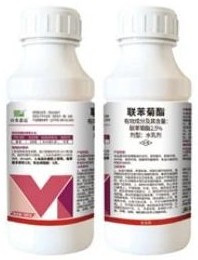
On its Chinese registration, the BNSD Agro 2.5% EW is registered for tomato whitefly at 30–40 mL per 667 m² (one mu, 1/15 ha) as a foliar spray.
The EW formulation is the point here. An EW (emulsion in water) carries the active in an oil-in-water system instead of the large organic-solvent load of a conventional EC. For this product that means low solvent content, low odour and crop safety — a gentler profile on young foliage and under warm-season conditions, with less flammable solvent in the pack. When comparing a bifenthrin EW against an EC quotation, buyers are comparing operator experience, crop safety and shipping profile, not just content. As always, the rate quoted is the Chinese registration label rate — in your market, follow the destination-market label.
The Granule Story: 1% Bifenthrin + Clothianidin granule (GR)
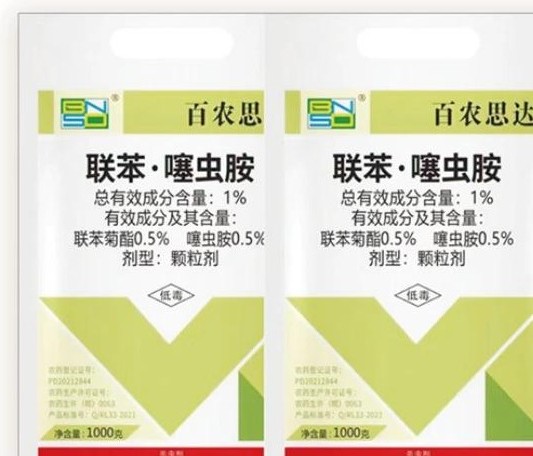
The most distinctive bifenthrin product on the list is not a spray. The 1% bifenthrin + clothianidin GR (packed 1 kg × 20 bags) is registered for chive and garlic root maggots — the soil-dwelling larvae that destroy stands underground where foliar sprays never reach.
The company describes the granule as fully water-soluble, dissolving in about 30 seconds — technology that lets the product go into solution for liquid application without residue plugging screens or emitters, according to the product information. Application method and rate follow the label of the destination market.
The pairing logic is the same soil-pest playbook used across the industry: bifenthrin (IRAC 3A) contributes contact activity on larvae in the soil zone, while clothianidin (IRAC 4A, neonicotinoid) contributes systemic uptake through the root — two unrelated modes of action against one target.
The Combination Range at a Glance
Beyond the single-active 2.5% EW, the bifenthrin combinations on file (company information) are:
| Product | Registered target (Chinese label) | Label rate |
|---|---|---|
| 2.5% bifenthrin EW | Tomato whitefly | 30–40 mL/667 m² |
| 15% flonicamid + bifenthrin suspension concentrate (SC) | Peach aphids | 4000–5000× dilution |
| 5% bifenthrin + thiamethoxam SC | Wheat aphids | 30–50 mL/667 m² |
| Bifenthrin 100 g/L EC + thiamethoxam 25% water-dispersible granule (WDG) co-pack | Jujube mirid bug, onion thrips, garlic root maggot, rice planthopper, chive maggot, tea leafhopper | Per respective labels |
| 1% bifenthrin + clothianidin GR | Chive and garlic root maggots | Per label |
The design is consistent across the range: a pyrethroid brings contact knockdown, and the partner brings what bifenthrin lacks. Flonicamid (IRAC 9C, a selective feeding blocker) specialises in aphids; thiamethoxam (IRAC 4A) is systemic and takes sucking pests the pyrethroid only hits by contact. The co-pack of bifenthrin 100 g/L EC with thiamethoxam 25% WDG gives distributors two registered SKUs in one program, tank-mixed in the field across the listed targets.
Resistance Rotation for IRAC 3A
Pyrethroid resistance is the classic failure mode of this class — documented in aphid, whitefly and caterpillar populations wherever group 3A has been overused. The standard IRAC guidance applies:
- Do not follow a 3A application with another 3A application in the same pest generation, and cap the number of pyrethroid sprays per crop cycle.
- Rotate with unrelated modes of action as available and registered locally — group 4A neonicotinoids, group 6 avermectins, group 9C feeding blockers, group 28 diamides.
- Treat the mixtures above as rotation tools, not excuses: a bifenthrin + thiamethoxam program still counts as a 3A exposure for resistance purposes.
FAQ
What is bifenthrin best used for?
Contact and stomach control of chewing pests and a knockdown effect on many sucking pests, plus soil-dwelling larvae through the granule line. On the BNSD Agro Chinese registrations: tomato whitefly (2.5% EW), peach aphids (15% flonicamid combo), wheat aphids (5% thiamethoxam combo), and chive/garlic root maggots (1% GR). Always follow the destination-market label.
Why choose an EW instead of an EC?
The EW is water-continuous: low solvent load, low odour and better crop safety on sensitive foliage. The EC carries more organic solvent — still effective, but a different operator, crop and shipping profile. The formulation choice is part of the sourcing decision.
What does the 1% bifenthrin + clothianidin GR contain?
Two actives at 1% total — bifenthrin (IRAC 3A) and clothianidin (IRAC 4A) — registered for chive and garlic root maggots, packed 1 kg × 20 bags. The company describes the granule as fully water-soluble, dissolving in about 30 seconds. Method and rate per the destination-market label.
How should bifenthrin be rotated?
With other IRAC groups — 3A should not follow 3A within a pest generation, and pyrethroid applications per crop cycle should be capped. Pair with group 4A, 6, 9C or 28 products as registered locally.
What co-pack options does BNSD Agro offer?
A co-pack of bifenthrin 100 g/L EC with thiamethoxam 25% WDG, covering jujube mirid bug, onion thrips, garlic root maggot, rice planthopper, chive maggot and tea leafhopper programs on the respective Chinese labels.
The bifenthrin range sits within the 43-SKU insecticides and acaricides catalogue, and the granule line with the full list of mediated fertilizers is on the insecticide-fertilizer granules page. For samples, registration documents or OEM packing, contact BNSD Agro.
WhatsApp / WeChat: +86 199 0636 5856