
When two formulations of the same active sit side by side at the same content — 4.5% EC and 4.5% EW — buyers reasonably ask what actually separates them. In the case of beta-cypermethrin, the answer involves both the molecule (an enriched isomer pair) and the formulation system (solvent-based versus water-based), each carrying its own registered use. This guide explains the “beta” prefix, lays out the two 4.5% registrations held by BNSD Agro (Shandong Bainong Sida Biotechnology Co., Ltd.), and walks through the practical trade-offs an importer weighs when choosing between EC and EW for a given market.
What “Beta” Means: the High-Activity Isomer Pair
Cypermethrin, like many pyrethroids, is a mixture of stereoisomers — chemically identical molecules that differ in three-dimensional orientation. Only some of those isomers carry meaningful insecticidal activity. Beta-cypermethrin is the enriched form: a re-proportioned product in which the two most active isomer pairs dominate the mixture, with the weak isomers reduced.
The practical consequences are well established:
- Higher activity per unit of active content. Because more of the content is the active isomer, a given percentage delivers more effective molecule than the ordinary form — the reason “beta” became the standard trade quality for cypermethrin.
- Same mode of action as the rest of the pyrethroids. Beta-cypermethrin is an IRAC group 3A sodium-channel modulator with contact and stomach action and the fast knockdown typical of the group. There is no systemic movement in the plant; coverage decides performance.
- Same resistance behaviour. Cross-resistance within group 3A applies, which makes rotation discipline non-negotiable (see below).
The Two 4.5% Registrations
On the Chinese label, the two formulations divide the targets between them:
| Formulation | Registered use (Chinese label) | Label rate | Defining trait |
|---|---|---|---|
| 4.5% EC | Diamondback moth + cowpea pod borer | 30–40 mL/667 m² | Solvent-based classic system |
| 4.5% EW | Cabbage worm | 30–50 mL/667 m² | Water-rich, low solvent |
All rates are Chinese registration label rates (667 m² = one mu ≈ 1/15 ha). Registration scopes and rates differ by country — always follow the destination-market label.
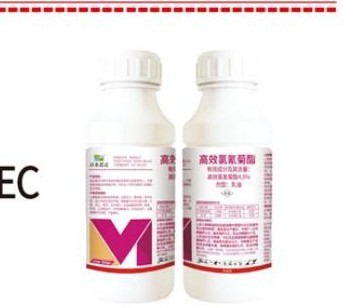
4.5% EC: diamondback moth and cowpea pod borer
The emulsifiable concentrate is the traditional workhorse of the pyrethroid trade: the active dissolved in organic solvent with an emulsifier system that turns the concentrate into a sprayable emulsion in the tank. On the Chinese label it is registered against diamondback moth and cowpea pod borer at 30–40 mL/667 m². Both are demanding targets in their own way — diamondback moth because of its notorious resistance history, cowpea pod borer because larvae bore into pods quickly, which makes timely contact kill and thorough coverage essential.
4.5% EW: cabbage worm with less solvent
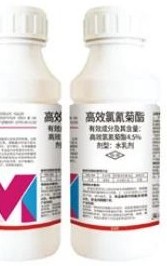
The emulsion-in-water formulation carries the cabbage worm registration at 30–50 mL/667 m², and its defining trait is the low solvent load: water replaces most of the organic solvent as the continuous phase. For brassica crops — cabbage worm’s home ground — that shift matters in the field: less odour, less risk of a phytotoxic reaction on tender foliage, and a more comfortable handling profile for operators who spend the day with the sprayer.
EC vs EW: the Practical Trade-offs
For an importer choosing between the two, the comparison reduces to a handful of well-understood differences:
- Formulation robustness. EC is the older, simpler system; it tolerates a wide range of water qualities and tank-mix partners. EW demands more from the manufacturer — the emulsion must be milled and stabilised — but a well-made EW is stable in hard water too.
- Solvent content. EC carries organic solvent: more odour, a stronger skin and eye irritation profile, and flammable cargo classification for transport. EW carries far less solvent, which lowers odour, operator discomfort and DG handling burden.
- Crop fit. Solvent-heavy formulations carry a higher risk of phytotoxic marking on sensitive, tender foliage — the reason EW is often preferred in leafy brassicas and greenhouse settings where the EC’s solvent would be the limiting factor.
- Cost. EC typically prices lower per litre; EW’s water-based system costs more to manufacture but buys the handling and crop-tolerance advantages above.
Neither system is universally “better”. The decision is market-shaped: retail channels accustomed to EC economics, versus quality-sensitive vegetable markets where the EW’s low-solvent profile sells on its own.
IRAC 3A Rotation: the Non-Negotiable Part
Whatever the formulation, beta-cypermethrin is a group 3A pyrethroid, and the rotation rules are the same everywhere:
- Do not follow a group 3A application with another group 3A product against the same pest generation — pyrethroid cross-resistance is well documented.
- Cap the number of 3A applications per crop cycle and rotate with unrelated modes of action — group 4A neonicotinoids, group 1, group 6 or group 28 products, as registered locally.
- Treat diamondback moth with particular discipline: pyrethroid resistance in this pest is a long-standing, well-documented reality, so on brassicas a 3A product belongs inside a program, not as the program.
The fast knockdown and low cost per hectare that make 4.5% beta-cypermethrin attractive are exactly the qualities that invite overuse — which is why the rotation message belongs in the technical sheet you hand to your own distributors.
Both 4.5% formulations are listed in the insecticides and acaricides catalogue of BNSD Agro, alongside neonicotinoid partners for rotation programs. For samples, registration documents or OEM packing, contact BNSD Agro.
FAQ
Is beta-cypermethrin stronger than ordinary cypermethrin?
Per unit of active content, effectively yes: the “beta” form re-proportions the isomer mixture so the two most active isomers dominate, which raises insecticidal activity per gram compared with the ordinary mixture. This is why beta quality became the commercial standard for cypermethrin products.
Which should I import — 4.5% EC or 4.5% EW?
Follow the registrations and your channel. The EC is registered on the Chinese label against diamondback moth and cowpea pod borer (30–40 mL/667 m²) and prices as the solvent-based classic; the EW is registered against cabbage worm (30–50 mL/667 m²) and offers a low-solvent profile suited to leafy brassicas and quality-sensitive markets. In your own country, the destination-market label defines what each product may claim.
What is the difference between EC and EW formulations?
An EC dissolves the active in organic solvent and emulsifies into the tank water; an EW is an emulsion of the active in water, needing far less solvent. Practically: EC is the simpler, cheaper, more forgiving system but carries odour, irritation and flammability; EW is more demanding to manufacture but gentler on operators, crops and DG logistics.
How should beta-cypermethrin be rotated?
As an IRAC group 3A product: never follow 3A with 3A on the same pest generation, cap applications per crop cycle, and alternate with unrelated groups — 4A, 1, 6 or 28, as registered locally. For diamondback moth in particular, use it as one component of a managed program rather than as a stand-alone repeat spray.
WhatsApp / WeChat: +86 199 0636 5856