
Leaf spot is the disease pressure that decides how much functional leaf area a banana bunch has behind it. When spots merge and leaves die before the bunch fills, fruit weight, hand size and green-life all pay for it. The four fungicides below are the Chinese-registered leaf spot options in the BNSD Agro (Shandong Bainong Sida Biotechnology Co., Ltd.) portfolio — one QoI strobilurin, one twin sterol-inhibitor mixture and two single triazoles — and this guide compares them side by side at their label dilutions, then sets out the rotation logic that keeps all four working. The full line is in the fungicides catalogue, and samples or registration documents are available through the contact page.
The Banana Leaf Spot Complex
“Banana leaf spot” is shorthand for a complex of leaf diseases, the Sigatoka diseases chief among them. The shared pattern is well established: pale streaks appear parallel to the veins on young leaves, darken into necrotic spots with yellow halos, and merge until the leaf browns and dies ahead of its time. Infection is favoured by warmth, leaf wetness and high humidity — the standing climate of most banana zones — and new leaf flushes are the most vulnerable tissue. Because a banana stand carries leaves of every age at once and the cycle runs continuously through the wet season, leaf spot control in banana is a programmed, calendar-driven operation rather than a one-off rescue spray, and the choice of active for each pass matters as much as the interval.
Four Registered Options at a Glance
All four hold a Chinese registration for banana leaf spot. The dilution expressions below are orchard-style dilution sprays, matching how perennial fruit crops are planned.
| Product | Mode of action | Chinese label dilution |
|---|---|---|
| Pyraclostrobin 25% suspension concentrate (SC) | QoI strobilurin (FRAC 11), protectant-led | 1000–3000× |
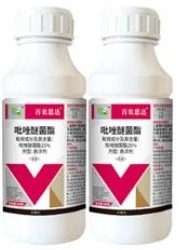
| Tebuconazole + prochloraz 400 g/L oil-in-water emulsion (EW) | Twin sterol-biosynthesis inhibitor: triazole (FRAC 3) + imidazole DMI | 1000–3000× |
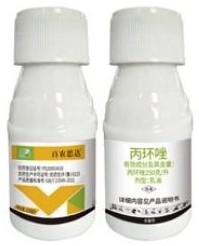
| Propiconazole 250 g/L emulsifiable concentrate (EC) | Triazole DMI (FRAC 3), systemic, curative-leaning | 500–1000× |
| Flusilazole 400 g/L EC | Triazole DMI (FRAC 3), systemic, curative-leaning | 500–1000× |
Reading the Four Options
Pyraclostrobin 25% SC — the protectant pass. Strobilurins are QoI respiration inhibitors (FRAC 11) whose strength is prevention: a protectant deposit on the young leaf flush, ahead of infection. Pyraclostrobin is also known in the trade for its physiological greening effect — treated foliage tends to hold its colour — which is one reason it anchors the early passes in many programs.
Tebuconazole + prochloraz 400 g/L EW — the built-in mixture. This EW pairs two sterol-biosynthesis inhibitors from different chemical families — the triazole tebuconazole and the imidazole prochloraz — so a single pass delivers two DMI targets, with the EW’s oil-in-water base aiding spreading on waxy banana leaves. It covers the window where protectant activity needs a curative partner in the same tank.
Propiconazole 250 g/L EC and flusilazole 400 g/L EC — the curative triazoles. Both are single triazole DMIs (FRAC 3): systemic, xylem-mobile, able to stop infections that have already begun and to arrest young lesions. Triazoles are the “put out the fire” chemistry of the program, and the EC formulation spreads well over the leaf surface. The propiconazole page in the catalogue carries the registration detail.
Rotation: Keeping Four Modes Alive
The program logic follows the standard FRAC framework, and the four products make it easy to run:
- Alternate FRAC 11 and FRAC 3 passes. A strobilurin pass on the flush, a DMI pass when pressure rises — never more consecutive applications of one group than the destination label allows.
- Let the mixture do a rotation in one pass. The tebuconazole + prochloraz EW carries two DMI targets at once, which lowers selection pressure per application compared with a single DMI.
- Keep a multi-site partner in the plan. Where a multi-site protectant is registered locally, it belongs between single-site passes as the resistance backbone — the same architecture used in banana plantations worldwide.
- Watch performance, not just lesions. QoI resistance is a known risk in FRAC 11 and DMI shifts develop in FRAC 3; if a pass underperforms at the registered rate, change the rotation before raising the dose.
All dilutions above are Chinese registration label rates, expressed as product-to-water dilution sprays. Registered uses, dilutions and spray intervals in your own market are defined by the destination label, which should always govern the final recommendation.
The resistance-management guide sets out the rotation framework in full. For label documents, samples or OEM packing of any of the four, contact BNSD Agro.
FAQ
Which of the four should open the season?
The protectant-led option: pyraclostrobin 25% SC on the young leaf flush ahead of infection, then bringing the DMI options in as pressure builds. A curative triazole works best when there is still live tissue to protect around a young lesion.
What is the difference between the two triazoles and the tebuconazole + prochloraz mixture?
The mixture delivers two sterol-biosynthesis inhibitors of different chemical families in one pass, cutting selection pressure on either single target; propiconazole and flusilazole are single DMIs, which makes them straightforward curative passes but places more weight on the rotation around them.
Why do the dilution ranges differ between products?
Each product carries its own registered range: the strobilurin and the mixture are labelled at 1000–3000×, the two triazoles at 500–1000×. Follow the range on the label that governs your market, and adjust within it by disease pressure and growth stage.
Can these be used outside China?
Only if registered there. Chinese registrations are a positioning reference for buyers; destination-market registration, label rates and spray intervals decide what is legal and correct locally, and destination labels should be obtained before any commercial program.
WhatsApp / WeChat: +86 199 0636 5856