
Bacterial plant diseases break the mental model most growers carry from fungicide work. There is no product that restores tissue already water-soaked and necrotic; the bacteria sit inside the plant, multiply in its vascular system, and spread with every splash of rain and every cut of a pruning knife. Bacterial disease control is therefore a defense of new growth and a suppression of spread — which puts as much weight on sanitation and timing as on the product in the tank.
This guide covers the kasugamycin family from the BNSD Agro (Shandong Bainong Sida Biotechnology Co., Ltd.) Chinese registration labels — kasugamycin 6% WP and the 45% kasugamycin + oxine-copper SC — and the integrated package that makes them hold: sanitation, copper-family partners, vector and wounding control, resistant varieties, and rotation.
Why Bacteria Have No Silver Bullet
- The pathogen is inside. Bacterial cells colonize intercellular spaces and vascular tissue, beyond the reach of any contact spray once infection is established. A “curative” pass can at best protect what is still healthy.
- Every wetting event spreads it. Rain splash, overhead irrigation and wind-driven drizzle move bacteria from lesions to new leaves; wounds from hail, insects and pruning are entry points.
- Lesions are sources, not symptoms. Each active lesion exudes bacteria; the field’s inoculum grows with every day an infected canopy stays untreated.
The practical consequence: spray protectively around weather that spreads bacteria, remove inoculum whenever the crop allows, and rotate genuine antibacterial modes of action.
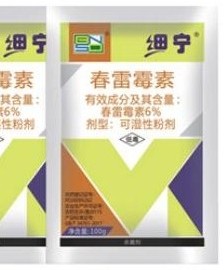
Kasugamycin 6% WP
Kasugamycin is an antibiotic active originally isolated from a soil Streptomyces, with a protein-synthesis-inhibiting mode of action against bacteria — a genuine antibacterial, not a broad enzyme inhibitor. On the Chinese label, kasugamycin 6% WP is registered against Chinese cabbage black rot at 25–40 g per 667 m², and the same WP is registered on rice blast at 40–50 g per 667 m². Its fit is the protective-and-early pass: applied at the first signs of lesion expansion or before a spreading weather window, it limits multiplication on new tissue.
45% Kasugamycin + Oxine-copper SC
For fruit trees, the Chinese label registers the 45% kasugamycin + oxine-copper SC on peach bacterial shot hole at 2000–3000× dilution, with citrus bacterial use possible per the destination label. The formulation pairs the antibiotic with oxine-copper — an organocopper bactericide — so one pass delivers two complementary modes: kasugamycin acting on bacterial protein synthesis, and the copper component as a residual protective film. For orchard programs, where the same canopy also needs protection through wet periods, the two-in-one formulation reduces the number of separate products a spray plan must carry.
The Integrated Package Around the Product
- Sanitation first. Prune out lesions with disinfected tools, remove and destroy infected plant debris rather than composting it in-field, and clean seed lots for crops where bacteria are seed-borne. No product compensates for a block that overwinters its own inoculum.
- Copper-family partners. Between kasugamycin passes, inorganic copper bactericides (hydroxide, oxychloride class) provide a multi-site protective option with no cross-resistance to the antibiotic — the classic rotation pair for bacterial leaf spots.
- Control the wounding agents. Insects create the entry wounds bacteria exploit; keeping chewing and sucking pests under control is genuine bacterial disease management, not a separate discipline.
- Resistant varieties and rotation. Where varieties with field tolerance exist, plant them into high-pressure blocks; for soil-borne bacterial problems, rotate away from susceptible hosts for as many seasons as the system allows.
- Mind the weather, not the calendar. Sprays belong ahead of forecast wet and stormy periods; a calendar pass in dry weather protects little, because spread has stalled.
Rotation and Resistance Care
Kasugamycin is a single-site antibacterial, and single-site products earn resistance when repeated without alternation. Treat it as the premium pass in a rotation: alternate with copper-family protectants, cap the number of kasugamycin applications per season per the destination label, and never extend rates beyond the label to chase a bad situation — underdosed or overdosed single-site sprays both select harder.
Program Summary
| Product | Chinese label reference use | Label rate | Role in the program |
|---|---|---|---|
| Kasugamycin 6% WP | Chinese cabbage black rot; rice blast | 25–40 g/667 m²; 40–50 g/667 m² | Antibacterial protective-and-early pass |
| 45% kasugamycin + oxine-copper SC | Peach bacterial shot hole | 2000–3000× | Two-mode orchard pass, antibiotic + organocopper |
All rates are Chinese registration label rates; registered crops, pests and rates differ by country — always follow the destination-market label.
Sourcing and OEM Notes
Bainong Sida holds 70 ICAMA registrations with about 60 pending, and releases each batch against the registration standard by HPLC/GC. The fungicide and bactericide range is listed in the fungicides catalogue; for samples, registration documents or OEM packing, contact the export team.
FAQ
What is the best treatment for bacterial leaf spot?
There is no curative spray for bacterial leaf spot — treatment is protective. On the Chinese labels held by Bainong Sida, kasugamycin 6% WP (registered on Chinese cabbage black rot at 25–40 g/667 m²) is the antibacterial pass, alternating with copper-family protectants between applications. Sanitation — removing infected debris and pruning with disinfected tools — decides how much the sprays have to accomplish.
Can kasugamycin be mixed with copper fungicides?
The 45% kasugamycin + oxine-copper SC already pairs the antibiotic with an organocopper in one registered formulation. For tank-mixing kasugamycin WP with other copper products, follow the destination label’s mixing provisions and jar-test first; copper formulations vary in compatibility.
How should bacterial disease products be rotated?
Alternate single-site antibacterials such as kasugamycin with multi-site copper-family protectants, cap kasugamycin applications per season, and never repeat the same single-site mode back-to-back within a disease cycle. Keep vector and wounding-pest control inside the same plan.
Why do bacterial diseases keep coming back every season?
The inoculum overwinters in plant debris, seed and alternate hosts inside the field. Without sanitation — debris removal, clean seed, tool disinfection — every season starts from the same infection base, and sprays only slow what sanitation would have prevented.
WhatsApp / WeChat: +86 199 0636 5856