
An apple orchard protection program earns its keep at three moments: the dormant spray that decides how much inoculum survives into spring, the in-season pass that keeps spider mites off the leaf surface, and the Alternaria window that decides whether the foliage holds through summer. Miss one and the others get more expensive; stack them correctly and the spray count stays short.
This guide assembles the program from the Chinese registration labels held by BNSD Agro (Shandong Bainong Sida Biotechnology Co., Ltd.) — a lime sulphur cleanup, an abamectin + pyridaben acaricide and two rotating Alternaria partners — with label rates and the season table that positions each one.
Dormant to Green Tip: Clean the Buds
Apple powdery mildew overwinters as mycelium inside infected buds, which makes the dormant period the cheapest control window of the year. On the Chinese label, lime sulphur 29% aqueous solution (AS) at 0.4–0.6 °Bé is registered on apple for powdery mildew, applied during dormancy before bud break. The spray suppresses overwintering inoculum on wood and buds, delaying the first colonies of spring and protecting the first flush of leaves.
Two rules travel with lime sulphur to every market: it is never mixed with oils or other pesticides, and the interval before the next spray stated on the destination label is respected absolutely. As a multi-site inorganic, it carries no practical resistance risk — the ideal chemistry for the one pass you want to be able to repeat every winter.
Red Spider Mite: Abamectin + Pyridaben 10.5% emulsifiable concentrate (EC)
In season, red spider mite is the population to watch from fruit set onward: colonies start on leaf undersides in the inner canopy, stippling turns to bronzing, and hot, dry weather compounds generations roughly weekly. The Chinese label registers 10.5% abamectin + pyridaben EC at 2500–3500× against apple red spider mite — abamectin (IRAC group 6) with post-application movement into leaf tissue plus pyridaben (IRAC group 21A) for fast knockdown, two unrelated modes of action in a single pass.
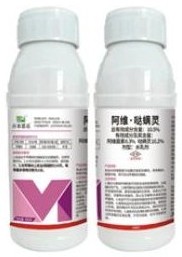
Monitoring should lead the spray: sample inner-canopy leaves through a lens and treat at threshold rather than on the calendar. Conserving predatory mites by not spraying before the threshold is ordinary IPM — and it keeps this product effective for more seasons.
Alternaria Leaf Spot: Rotate a Triazole with a QoI Mixture
Alternaria leaf spot builds through spring and summer on susceptible varieties, and the label provides two registered partners with different modes of action:
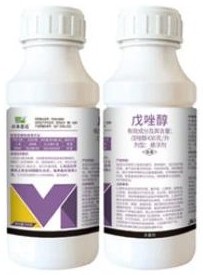
- Tebuconazole 430 g/L suspension concentrate (SC) at 5000–6000× — a triazole (FRAC group 3), systemic, with curative reach that stops expanding lesions and protects new growth.
- 60% pyraclostrobin + metiram water-dispersible granule (WDG) at 1500–2000× — a QoI (FRAC group 11) plus multi-site (FRAC M) mixture with a protectant-led profile and broad cover for the leaf surface.
Rotation is the point: a tebuconazole pass when curative action is needed, the pyraclostrobin + metiram mixture as the protective partner in between, and never one FRAC group in consecutive sprays. Standard practice across markets alternates the two through the risk period from petal fall through shoot growth.
Season Program at a Glance
| Phenological window | Target | Product | Chinese label rate |
|---|---|---|---|
| Dormant–green tip | Powdery mildew (overwintering inoculum) | Lime sulphur 29% AS | 0.4–0.6 °Bé |
| Petal fall–summer | Alternaria leaf spot | Tebuconazole 430 g/L SC | 5000–6000× |
| Alternating spray | Alternaria leaf spot | 60% pyraclostrobin + metiram WDG | 1500–2000× |
| Fruit set–summer | Red spider mite | 10.5% abamectin + pyridaben EC | 2500–3500× |
Windows are typical program positions, not label claims; the destination-market label defines crops, pests and doses. All rates shown are Chinese registration label rates.
Mixing and Compatibility Cautions
The classic orchard conflict applies here: mineral oil and lime sulphur must never be mixed, nor applied close together — the combination burns foliage, and the label-stated interval between them is the law of the program. Beyond that, general tank-mix discipline holds: jar-test unfamiliar combinations, add WDG and wettable powder (WP) products before SC and EC formulations, and watch water pH. Where an oil spray is part of the winter program, schedule it strictly apart from the lime sulphur pass.
Sourcing and OEM Notes
Bainong Sida holds 70 ICAMA registrations with about 60 pending, releases each batch against the registration standard by HPLC/GC, and supports OEM packing across more than eight formulation types, from 10 mL sachets to 40 kg drums. The orchard line spans the insecticides catalogue and the fungicide catalogue; for samples, registration documents or private-label packing, contact the export team.
FAQ
How do you control red spider mites on apple trees?
Monitor inner-canopy leaves and treat at threshold: on the Chinese label held by Bainong Sida, 10.5% abamectin + pyridaben EC is registered on apple red spider mite at 2500–3500×, combining an IRAC group 6 and a group 21A active for both knockdown and residual control. Underside coverage and mode-of-action rotation keep the treatment effective. Follow the destination-market label.
What is the dilution rate for abamectin + pyridaben on apple?
The Chinese registration label states 2500–3500× as a foliar spray. Your destination-market label will state its own dilution — it, not the Chinese figure, governs use in your market.
What causes Alternaria leaf spot on apples and when should you spray?
Alternaria fungi overwinter on infected wood and fallen leaves and build through warm, wet spring and summer weather. Program practice is to start protectant coverage around petal fall on susceptible varieties and rotate tebuconazole 430 g/L SC (5000–6000×) with 60% pyraclostrobin + metiram WDG (1500–2000×) through the risk period.
Can lime sulphur and mineral oil be used together?
No. The two must never be tank-mixed or applied within the label-stated interval of each other — the combination is phytotoxic to foliage and buds. In an apple program, each gets its own clear slot, with lime sulphur in the dormant window.
WhatsApp / WeChat: +86 199 0636 5856