
Every nutrition catalogue has a section that sits between fertilizer and crop care, and amino-acid products live there. An amino-acid water-soluble fertilizer is not a replacement for an NPK program — it is a biostimulant built from protein building blocks that the crop absorbs quickly and puts straight to work in its own metabolism. Used at the right moments, it shortens the gap between “nutrient applied” and “nutrient working”. This guide explains what amino acids actually do in the plant, when the timing pays off, what the BNSD Agro (Shandong Bainong Sida Biotechnology Co., Ltd.) pack range looks like, and what to check before you order from a biostimulant supplier.
Why Small Molecules Change the Math
A plant can build every amino acid it needs from mineral nitrogen, but doing so costs energy: it has to reduce the nitrogen, fix carbon skeletons through photosynthesis and assemble the molecules itself. When amino acids are supplied directly as small molecules, the crop takes them up through the leaf surface and young root tissue and routes them into protein synthesis and metabolism without paying that full cost first.
That is the core of the amino-acid biostimulant mode, and it has two practical consequences:
- Speed. Small molecules are absorbed fast, so the crop’s response window after a spray or drench is shorter than it is for mineral feeds that must be converted first. This is why amino-acid products are the usual choice when a grower wants the plant “running” again quickly rather than fed over weeks.
- Carrier effect. Amino acids bind metal micronutrients — zinc, iron, manganese — and carry them into the plant. In alkaline soils and alkaline spray water, where those elements tie up quickly, this chelating role is often as valuable as the nitrogen the product itself delivers.
Both points are general agronomy rather than product claims, and they explain why amino-acid fertilizers appear in programs across vegetables, orchards and field crops in every growing region.
What It Supports: Metabolism, Roots, Shoots
Agronomists generally attribute four functions to amino-acid biostimulants, and they map neatly onto what a grower sees in the field:
- Metabolism support. Amino acids are the raw material of enzymes and of the signalling compounds that govern growth. A direct supply keeps those processes stocked during peak demand — flowering, fruit fill, recovery after a setback — instead of forcing the crop to divert resources to build them.
- Root and shoot support. With carbon and nitrogen arriving pre-assembled, the crop has more to invest in new tissue. That is most visible at transitions: transplanting, the first root run after establishment, and regrowth after pruning or stress.
- Efficient organic nitrogen. The nitrogen in an amino-acid product is organic nitrogen, delivered with a low salt load compared with an equal amount of mineral N. Where salt accumulation is the constraint — substrates, saline water, closed systems — that difference matters.
- Micronutrient carriage. As above: the same molecule that feeds the crop also helps move trace elements into it.
These functions describe the category, not a promise for any one field; response always varies with crop, soil, water and season. What is consistent is the role: an amino-acid product fine-tunes the crop’s engine. It does not replace the fuel.
When the Timing Pays
Because the mode is fast and supportive rather than bulk-feeding, amino-acid water-soluble fertilizer earns its place at specific moments:
- Establishment. At transplanting and the weeks after, the priority is new root and shoot growth — exactly the investment amino acids support.
- Before and during peak demand. Pre-flowering and fruit set are high-stress, high-metabolism windows; a biostimulant pass before them gives the crop reserves to draw on.
- Recovery windows. After cold snaps, heat waves or other stress events, the crop needs to rebuild proteins; small-molecule supply is the direct way to help.
- Alongside the main program, not instead of it. The NPK program still supplies the bulk nutrition. Amino acids are layered on top at the moments above, following the label rate and interval for the product.
All rates and intervals follow the product label for the Chinese market; adjust to the crop stage, the water analysis and destination-market guidance before use in other countries.
The Pack Range
The BNSD Agro amino-acid water-soluble fertilizer is fully water-soluble for spray and drench use and packed on a three-step ladder:
| Pack | Carton count | Typical user |
|---|---|---|
| 50 g sachet | 200 per carton | Retail single-dose: one sachet per knapsack tank; smallholder plots |
| 500 g bag | 20 per carton | Dealer shelves; greenhouse and orchard sprays |
| 1 kg pack | 12 per carton | Farm-scale programs; repeated drench and drip passes |
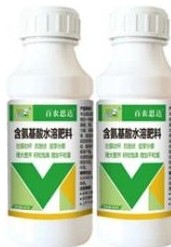
The ladder is deliberate. The 50 g sachet turns the product into a retail single-dose item that a smallholder can buy one spray at a time; the 500 g bag fits the dealer counter and a family greenhouse; the 1 kg pack keeps packaging cost down for farm-scale programs. Importers and distributors usually stock the mix that matches their channel.
Sourcing Checks Before You Order
Biostimulants are a category where specification discipline matters more than slogan discipline. Before committing to a supplier, make four checks:
- Declared content and origin. Ask what amino-acid content is declared on the label and what raw material source the product is made from. Request the specification sheet and a certificate of analysis, not just a brochure.
- Full solubility. “Water-soluble” should mean the product dissolves completely and passes a spray filter or drip emitter without residue. Ask for solubility data.
- Compatibility. As with any concentrated feed, jar-test before tank-mixing — especially with calcium-rich products or strongly acidic or alkaline mixes. When in doubt, run a separate pass.
- Market documents. Registration categories for biostimulants differ by destination market. Ask which documents the supplier provides — technical data, COA, samples — to support local registration and buyer audits.
A supplier that answers those four questions with documents rather than adjectives is the supplier whose product will perform the same in your third container as it did in the sample.
The amino-acid product sits in the BNSD Agro nutrition line alongside NPK grades, fulvates and micronutrient blends — see the nutrition products page. For specifications, samples or OEM packing, contact BNSD Agro.
FAQ
Is amino-acid fertilizer a substitute for NPK?
No. It works alongside the NPK program. The bulk of nitrogen, phosphorus and potassium still comes from the main fertilizer plan; the amino-acid product supports uptake and metabolism and adds a modest amount of organic nitrogen. Treating it as a replacement leaves the crop short of bulk nutrition.
Should it go on the leaf or through the drip line?
Both routes work, and the choice follows the goal. Small molecules absorb well through leaf surfaces, so foliar spray is the fast route for a quick response window; drench or drip application places them in the root zone for establishment and recovery passes. Follow the label rate and interval for each route.
Can it be tank-mixed with pesticides?
Amino-acid solutions are commonly combined with mainstream pesticide sprays in practice, but compatibility always deserves a jar test first. Avoid strongly alkaline mixes and calcium-heavy concentrates, and when a mix is unproven, keep a separate pass for the biostimulant.
Why do the packs jump from 50 g to 1 kg?
The three-step ladder serves different buyers. The 50 g sachet is a retail single-dose unit — one sachet per knapsack tank. The 500 g bag fits dealer shelves and small greenhouses. The 1 kg pack minimizes packaging cost per pass for farm-scale programs. Importers typically take the mix that matches their sales channel.
WhatsApp / WeChat: +86 199 0636 5856