
Some insecticides are bought by the drum; acetamiprid 70% WDG is bought by the sachet. At label rates measured in single grams per mu, it is one of the most pack-sensitive products in any insecticide catalogue — the pack design is not an afterthought but the commercial core. This guide explains what the molecule is, what the Chinese label actually registers, why the 4 g sachet leads the range at BNSD Agro (Shandong Bainong Sida Biotechnology Co., Ltd.), and how to rotate it without wasting its value.
Acetamiprid in Brief: IRAC Group 4A
Acetamiprid is a neonicotinoid insecticide classified in IRAC group 4A, acting on nicotinic acetylcholine receptors in the insect nervous system. For buyers, three well-established properties matter:
- Strong aphid activity. Group 4A chemistry is built around sap-feeding pests, and aphids are the classic target: contact kill on the deposit plus stomach kill as the pest feeds on treated tissue.
- Systemic plus contact action. The active is taken up and translocated in the plant, adding residual protection on new growth to the immediate contact effect.
- Performance in cooler conditions. Within the neonicotinoid group, acetamiprid is generally regarded as retaining better activity at lower temperatures — a practical point for early-season and protected-culture programs.
As with all 4A actives, the environmental profile is the constraint: highly toxic to bees and aquatic organisms, which shapes the timing rules below.
The Registered Use: Cucumber Aphids at 1.5–2.5 g per Mu
On the Chinese registration held by BNSD Agro, acetamiprid 70% WDG is registered against aphids on cucumber at 1.5–2.5 g/667 m², applied as a foliar spray. The band is worth pausing on. A mu is 667 m² (1/15 ha), so the top of the label band is two and a half grams of product for a full mu of cucumber canopy. In practical terms a grower weighs the dose against spray volume and coverage — aphid colonies sit on the underside of leaves and in growing points, so the spray has to reach those zones.
Beyond cucumber, the same 70% WDG is the acetamiprid option referenced in BNSD Agro’s crop program notes for cotton aphids, and it appears in cucumber thrips positioning as well (company program information). Registration scopes differ by country, so the destination-market label — not this article, and not the Chinese label — governs what can be claimed in your market.
The low dose also changes how the product behaves economically. One kilogram of 70% WDG covers roughly 400–600 mu at label rates. Freight, warehouse space and shelf slots all shrink accordingly — which is why the pack story below matters as much as the chemistry.
Why the 4 g Sachet Leads the Range
The pack ladder for acetamiprid 70% WDG is deliberately sachet-first:
- 4 g × 1000 sachets — the retail workhorse. At 1.5–2.5 g per mu, a single 4 g sachet is one to two mu of aphid control, pre-measured. The grower tears, pours, sprays; there is no weighing, no spillage, no under-dosing risk that comes from splitting a bulk pack by eye.
- 100 g × 80 jars — the farm-store and cooperative size, for growers who treat larger blocks and measure per tank.
This sachet-first logic is the standard pack strategy for gram-dose products: retail channels need countable, pre-measured units that make the label rate foolproof, while wholesale and plantation channels need the jar and bulk end for freight efficiency. When comparing supplier quotations, pack design is a genuine quality signal — a sachet that seals poorly, powders excessively or bridging granules that will not pour all translate directly into field complaints.
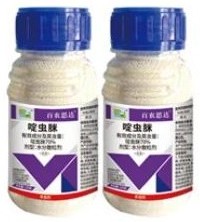
For sourcing generally, the checks that matter on a 70% WDG are the same as for any high-content water-dispersible granule: a certificate of analysis that matches the declared content, granules that disperse quickly with light agitation and hold a uniform suspension, no caking after compression, and documents — registration certificate, production licence, batch traceability — in the supplier’s own name.
Rotation and Stewardship
Acetamiprid’s value is perishable if it is used carelessly. Standard IRAC discipline for group 4A applies:
- Do not follow a group 4A application with another group 4A product against the same pest generation — rotating acetamiprid into imidacloprid or thiamethoxam is not a rotation at all.
- Cap the number of 4A sprays per crop cycle. In intensive vegetable systems where aphid pressure recurs, alternate with unrelated modes of action: group 3A pyrethroids, group 1 carbamates and organophosphates, group 6 avermectins or group 28 diamides, as registered locally.
- Monitor efficacy. Where aphid populations survive a correctly applied 4A spray, treat it as a resistance signal, not a dose problem — and switch groups rather than stacking rates.
Pollinator timing completes the stewardship package: never spray flowering crops, spray in the evening when pollinators are least active, prevent drift to flowering weeds and neighbouring crops, and follow the bee-protection provisions of the destination-market label. Cucumber crops are routinely visited by bees in greenhouse pollination programs, which makes this rule especially concrete in the product’s headline crop.
The 70% WDG sits in the insecticides and acaricides catalogue of BNSD Agro alongside the other group 4A products and pyrethroid partners for rotation. For samples, registration documents or OEM sachet packing, contact BNSD Agro.
FAQ
How much acetamiprid 70% WDG is used per 667 m²?
The Chinese label for cucumber aphids specifies 1.5–2.5 g/667 m² as a foliar spray. Rates are label properties, so always transfer them from the destination-market label in your own country rather than from this article.
What is the 4 g sachet designed for?
The retail channel. At 1.5–2.5 g per mu, one 4 g sachet covers one to two mu, pre-measured so no weighing is needed in the field. The 4 g × 1000 sachet box is the standard retail unit; the 100 g × 80 jar serves farm stores and growers treating larger blocks.
Can acetamiprid be rotated with imidacloprid or thiamethoxam?
No — all three are IRAC group 4A, so switching between them is not a resistance-management rotation. Rotate with unrelated groups: pyrethroids (3A), carbamates and organophosphates (1), avermectins (6) or diamides (28), as registered locally, and cap total 4A sprays per crop cycle.
Is acetamiprid dangerous to bees?
Yes — like all group 4A actives it is highly toxic to bees. The baseline rules: never spray flowering crops, spray in the evening, prevent drift to flowering vegetation, and follow the bee-protection statements of the destination-market label. In greenhouse cucumber production, coordinate spraying with pollination schedules.
WhatsApp / WeChat: +86 199 0636 5856