
The abamectin-versus-emamectin question is a fixture on a Chinese manufacturer’s export desk. Buyers see both molecules sitting in IRAC group 6, notice the price gap per kilogram, and ask which one to position in their market — or whether one simply replaces the other. The honest answer is that they are related but not interchangeable: one is the natural product, the other its upgraded derivative, and their registered uses, use rates and cost positions reflect that difference. This guide compares the two from the standpoint of BNSD Agro (Shandong Bainong Sida Biotechnology Co., Ltd.), using the registered products and Chinese label rates on file plus the general chemistry every buyer should know.
Two Avermectins, One Mode of Action
Abamectin and emamectin benzoate are both avermectins, classified in IRAC group 6. The group’s mode of action is well established: allosteric modulation of glutamate-gated chloride channels in insect nerve cells, which disrupts signalling, stops feeding and leads to death. Three properties are shared across the group:
- Contact and stomach activity. Larvae die when they feed on treated surfaces or pick up the spray deposit directly.
- Translaminar movement. The active moves into leaf tissue, forming a reservoir that larvae feeding on the leaf underside cannot avoid — useful where spray coverage is imperfect.
- Little systemic movement. Neither molecule is xylem-mobile in any useful sense, so coverage still matters.
Where they part ways is origin and potency. Abamectin is the natural fermentation product of the soil bacterium Streptomyces avermitilis, applied essentially as the fermentation produced it. Emamectin benzoate is the semi-synthetic derivative: an abamectin molecule chemically modified with a methylamino group that sharpens stomach-led activity and raises potency per gram considerably, particularly against Lepidoptera. It is marketed as the benzoate salt — a form chosen because the salt improves water solubility and storage stability relative to the free base, which is why the molecule performs so well in solid formulations such as water-dispersible granules.
Side by Side: The Comparison Buyers Ask For
| Aspect | Abamectin | Emamectin benzoate |
|---|---|---|
| Origin | Natural fermentation product (avermectin B1) | Semi-synthetic derivative of abamectin |
| IRAC group | 6 | 6 |
| Activity profile | Contact + stomach, translaminar; mite activity as well | Stomach-led, translaminar; Lepidoptera specialist, more potent per gram |
| Single-active formulations (BNSD Agro) | 1.8% EC; 5% EC; 5% micro-emulsion (ME) | 5% WDG; 1% EC |
| Typical Chinese label rates | Diamondback moth 30–40 mL/667 m² (1.8% EC); rice leaffolder 8–16 mL/667 m² (5% ME); cabbage worm 10.8–14 mL/667 m² (5% EC) | Cabbage diamondback moth 3–4 g/667 m² (5% WDG); beet armyworm 10–20 mL/667 m² (1% EC) |
| Mites | Yes — the 10.5% abamectin + pyridaben EC is registered for apple red spider mite | Not the registered focus |
| Cost positioning | Mature fermentation product, lower cost per litre, higher use rates | Higher price per kilogram, far lower use rates per mu |
All rates quoted here are Chinese registration label rates (667 m² = one mu, 1/15 ha). In your own market, always follow the destination-market label — the registered crops, targets and rates of the same product differ between countries.
What the Rate Gap Tells You
Compare the flagship registrations: emamectin benzoate 5% WDG controls cabbage diamondback moth at 3–4 g/667 m², while abamectin 1.8% EC needs 30–40 mL/667 m² for the same target. Even allowing for the different contents, a mu of brassicas receives only a fraction of the active ingredient when the emamectin product is used. That potency is the entire commercial case for the derivative — more activity per gram shifts the cost-per-hectare calculation despite a higher price per kilogram. Abamectin answers on the other side of the ledger: a mature fermentation product with lower material cost, a broader registered portfolio and mite activity that the derivative does not claim.
The Abamectin Range: Formulations and Registered Uses
BNSD Agro’s abamectin portfolio (company information) spans single actives and combinations:
- 1.8% EC — diamondback moth on brassicas at 30–40 mL/667 m², the classic entry product of the class;
- 5% ME — rice leaffolder at 8–16 mL/667 m²;
- 5% EC — cabbage worm at 10.8–14 mL/667 m²;
- 10.5% abamectin + pyridaben EC — apple red spider mite at 2500–3500× dilution, the acaricide position that shows the molecule’s mite side;
- 1.8% abamectin + beta-cypermethrin EC — diamondback moth and cabbage worm at 28–56 mL/667 m²;
- 2.5% abamectin + hexaflumuron EC — beet armyworm and diamondback moth at 30–40 g/667 m².
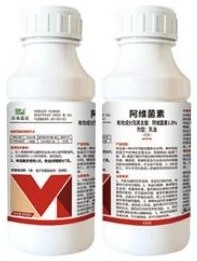
The structure is typical of a mature avermectin line: a ladder of contents and formulation types, each carrying its own registration, with mixtures that pair the group 6 activity with unrelated partners — a pyrethroid for knockdown (beta-cypermethrin, IRAC 3A) or an insect-growth regulator (hexaflumuron) for residual control.
The Emamectin Benzoate Range: WDG, EC and Combinations
The emamectin line (company information) is built around the caterpillar franchise:
- 5% WDG — cabbage diamondback moth at 3–4 g/667 m², packed from 10 g × 800 sachets up to 100 g × 100 bags, a pack ladder that serves smallholder retail through farm cooperatives;
- 1% EC — beet armyworm on brassicas at 10–20 mL/667 m²;
- 11.6% emamectin + chlorantraniliprole suspension concentrate (SC) — diamondback moth at 5–10 mL/667 m², pairing IRAC 6 with the diamide group 28;
- 9.8% emamectin + lufenuron SC — diamondback moth at 10–15 mL/667 m², adding an insect-growth-regulator partner;
- 3.2% emamectin + beta-cypermethrin ME — beet armyworm at 40–60 mL/667 m².
Rotation Guidance for IRAC 6
Because both molecules share the group 6 target site, the standard IRAC guidance applies to both equally:
- Do not follow a group 6 spray with another group 6 spray in the same or next pest generation — abamectin does not “rotate” with emamectin, however different the two labels look.
- Cap the number of group 6 applications per crop cycle, particularly in brassicas, where diamondback moth is a notorious resistance former.
- Rotate with unrelated modes of action as available and registered locally: IRAC 3A pyrethroids, group 28 diamides, insect-growth regulators or group 1 compounds.
- Treat mite and caterpillar pressures as separate selection problems — the 10.5% abamectin + pyridaben EC carries a different partner for a reason.
Combination products are part of this logic. Pairing group 6 with an unrelated partner inside one registration — chlorantraniliprole, lufenuron, beta-cypermethrin — puts two modes of action into every application and slows the selection pressure on either one.
The full range of 43 insecticide and acaricide export SKUs is listed in the insecticides and acaricides catalogue. For samples, registration documents or OEM packing, contact BNSD Agro.
FAQ
Which is more potent, abamectin or emamectin benzoate?
Emamectin benzoate, by a clear margin. It is a semi-synthetic derivative engineered for higher stomach-led activity against caterpillars, and the registered rates show it: 3–4 g/667 m² of the 5% WDG against diamondback moth, versus 30–40 mL/667 m² of abamectin 1.8% EC for the same target. Rates in your market follow the destination-market label.
Does abamectin control mites?
Yes — mite activity is a defining feature of the natural product. In the BNSD Agro range, the 10.5% abamectin + pyridaben EC is registered for apple red spider mite at 2500–3500× dilution on the Chinese label, combining the avermectin with a dedicated acaricide partner.
Why is emamectin benzoate sold as a salt?
The benzoate salt improves water solubility and storage stability compared with the free base, which is why the molecule performs so well in water-dispersible granules such as the 5% WDG. It is salt chemistry, not an additional active ingredient.
Can I rotate abamectin with emamectin benzoate?
No. Both are IRAC group 6 and act at the same target site, so alternating them does nothing for resistance management. Rotate with genuinely different groups — 3A pyrethroids, group 28 diamides, growth regulators or group 1 compounds — as registered locally.
What is the difference between abamectin 5% ME and 5% EC?
They are separate registrations. The 5% ME is registered for rice leaffolder at 8–16 mL/667 m²; the 5% EC for cabbage worm at 10.8–14 mL/667 m². A microemulsion and an emulsifiable concentrate also behave differently in the tank and on the crop. Always follow the destination-market label for both use and rate.
WhatsApp / WeChat: +86 199 0636 5856